Blog

  • 731% Organic Traffic Growth for an Indore IT Startup — In 12 Months: SEO Case Study India

    731% Organic Traffic Growth for an Indore IT Startup — In 12 Months: SEO Case Study India

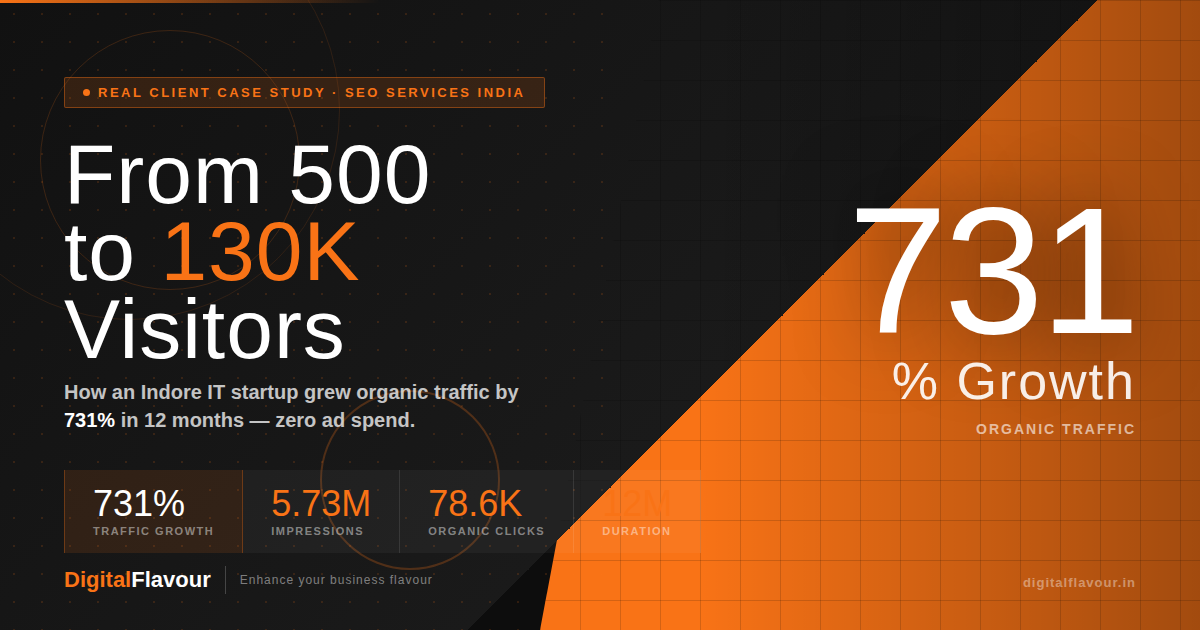
    731% User Growth130K+ Monthly Users5.73M Impressions78.6K Organic Clicks

    The Client

    An Indore-based IT services and software development startup. Clients in India and the USA. Small team, solid services — but practically invisible on Google when they came to Digital Flavour.

    Starting point: 500–700 organic visitors per month, almost entirely branded searches. Zero inbound leads from search. Zero presence for any commercial keyword.

    What Was Holding Them Back

    • Service pages with under 300 words and no keyword targeting
    • No blog, no content — nothing for Google to rank
    • Technical issues: slow speed, missing meta tags, no sitemap
    • Near-zero backlinks — Google had no reason to trust the domain
    • No geo-targeted content for the US market

    What We Did (12-Month Roadmap)

    Months 1–2: Fixed the Technical Foundation

    Resolved all crawl errors. Optimized page speed. Website Structure. Set up Google Search Console. Wrote proper title tags and meta descriptions for every page. Added schema markup, fixed Internal linking & Anchor text. Fixed Image Alt Text with Relevant Keywords. Without this, nothing else works.

    Months 2–4: Built the Content Engine

    Rewrote all service pages with proper keyword targeting. Launched a blog publishing 10-12 posts per month — each targeting a specific keyword with real search volume. Every post linked back to the relevant service page.

    Months 4–8: Built Authority Through Link Building

    Guest posts on Indian and international tech publications. Digital PR placements. Relevant directory submissions, Citation Submissions, business listings. The domain went from negligible authority to a steadily growing backlink profile.

    Months 7–12: Targeted the US Market

    Created dedicated landing pages and content specifically for US businesses looking to outsource software development to India. This single move opened an entirely new lead channel within 6–7 months.

    The Results — Verified From Google Analytics & Search Console

    MetricBeforeAfter (12 months)
    Organic users / month500–700130,000+  (+731%)
    Monthly sessions~600161,000+  (+680%)
    Google impressionsVery low5,730,000
    Organic clicksNegligible78,600+
    US inbound leadsZeroRegular monthly enquiries

    Client feedback: “We started getting inbound leads from the US after 6–7 months. We had never received a single international enquiry before this. SEO completely changed how we think about our online presence.”

    3 Things This Case Study Proves

    • 1. SEO compounds. Traffic grew slowly at first, then accelerated sharply after month 5. Every piece of content we published kept working long after it went live.
    • 2. Indian companies can win international clients through organic search. The right content strategy puts you in front of US businesses actively looking for what you offer.
    • 3. You don’t need ad spend. Every visitor in this case study came from organic search — zero Google Ads budget.

    Quick FAQs

    How long does SEO take in India?

    Expect first results in 3–4 months. Significant growth by month 8–12. The compounding effect kicks in after that.

    Does SEO work for IT and B2B companies?

    Yes — this case study is proof. B2B buyers search Google before shortlisting vendors. Ranking well means you get found before your competitors do.

    What did this cost?

    Contact us for a custom quote. Think of it as ROI, not cost — one US enterprise contract from organic search can return the entire investment many times over.

    Ready to Grow Your Organic Traffic? Get a free SEO audit for your website. No commitment, just clarity. Contact Digital Flavour 
    About Digital Flavour : Digital Flavour is a results-driven digital marketing agency helping Indian startups and SMBs grow through SEO, content strategy, and performance marketing — targeting both Indian and international markets.
  • Best digital marketing services for small businesses in India

    Best digital marketing services for small businesses in India

    If you run a small business in India and you’re trying to figure out where to spend your marketing budget — you’re in exactly the right place. This guide by Digital Flavour, Best Digital Marketing Agency covers every major digital marketing services for small business, what each one does, how much it costs in India, and most importantly, which ones are worth your rupees.

    What’s Inside

    1. Why Digital Marketing Matters for Indian SMBs
    2. SEO – Long-Term Organic Growth
    3. Social Media Marketing
    4. Google Ads / PPC
    5. Content Marketing
    6. Web Design & Development
    7. Email Marketing
    8. Pricing Guide 2026
    9. How to Choose the Right Services
    10. FAQs

    Why Digital Marketing Is No Longer Optional for Small Businesses in India

    India’s internet user base crossed 800 million in 2025. Your customers are already online — searching on Google, scrolling Instagram, watching YouTube Shorts, and comparing prices on their phones before they even step into a store or pick up the phone to call you.

    If your business doesn’t show up in those moments, a competitor will. Digital marketing levels the playing field. A well-run ₹30,000/month SEO campaign can put a small local business above a national chain in Google search results — something that was impossible with traditional advertising.

    800M+Internet users in India in 2025

    ₹70,000 CrProjected digital ad spend in India by end of 2026

    3xHigher engagement on Reels & Shorts vs static posts for Indian brands

    The good news? You don’t need to do everything at once. The smartest small businesses in India start focused — one or two services done well — and scale up once they see results. Let’s break down each service so you can make that call confidently.

    1. SEO (Search Engine Optimization) — Your Best Long-Term Investment

    Search Engine Optimization (SEO)

    Best for Long-Term Growth

    SEO is the process of making your website show up on Google (and now on AI tools like ChatGPT and Gemini) when people search for what you offer. Unlike paid ads, the traffic from SEO doesn’t stop when your budget runs out.

    For a small business in India, SEO typically includes on-page optimization (fixing your website’s content and structure), local SEO (showing up in “near me” searches and Google Maps), technical SEO (making sure Google can read your site properly), and link building (getting other websites to reference yours).

    What makes it special for Indian small businesses: Local SEO is extremely powerful and affordable. If you run a dental clinic in Bhopal or a bakery in Pune, optimizing your Google Business Profile alone can bring in consistent walk-in customers every week.

    Results in 3–6 months , ₹10,000–₹50,000/month, Best ROI over 12+ months

    What SEO Does for Your Small Business

    • Puts your business at the top of Google when customers search for your product or service
    • Gets you featured in Google Maps and the “local pack” for location-based searches
    • Helps AI tools like ChatGPT and Gemini recommend your business when users ask relevant questions
    • Builds brand credibility — people trust organic search results more than ads
    • Reduces your long-term customer acquisition cost significantly

    Honest heads-up: SEO is a marathon, not a sprint. If someone promises you “#1 on Google in 7 days,” run the other way. Genuine SEO results in India take 3–6 months to become visible, but the compounding returns are worth the wait.

    2. Social Media Marketing — Build Your Brand Where Your Customers Hang Out

    Social Media Marketing

    Best for Brand Building

    India is one of the world’s largest social media markets. With over 500 million Instagram users and nearly 400 million on Facebook, social media is where your audience is spending time every single day.

    Social media marketing for small businesses includes content creation (posts, Reels, Stories), community management (responding to comments and DMs), paid social ads (boosting posts or running targeted campaigns), and influencer collaborations.

    Platform guide for Indian small businesses: Instagram and Facebook work best for B2C businesses (retail, food, fashion, services). LinkedIn is the go-to for B2B businesses. YouTube Shorts and Reels are seeing massive organic reach right now — if you can create short video content consistently, this is a huge opportunity.

    Results in 2–3 months, ₹15,000–₹60,000/month, Best for awareness & trust

    Social Media Tips for Indian Small Businesses in 2026

    • Use vernacular content: Brands using Hindi, Tamil, or other regional languages in social media campaigns are seeing engagement rates triple compared to English-only content
    • Reels first: Short video content on Instagram and YouTube gets 3x more reach than static posts — prioritize video even if it’s just 30–60 seconds filmed on a phone
    • Consistency beats perfection: Posting 3–4 times per week with good captions beats posting 1 polished piece per month
    • Reply to every comment: Engagement signals matter for algorithm reach, and it builds genuine community trust

    3. Google Ads / PPC — Get Leads Fast When You Need Them

    Google Ads & PPC (Pay-Per-Click)

    Best for Immediate Results

    While SEO builds visibility over months, Google Ads puts your business at the top of search results from day one. You pay only when someone clicks your ad — making it highly measurable and controllable.

    For small businesses in India, the most effective PPC formats are Google Search Ads (showing up when someone searches for your service), Google Local Ads (appearing in Google Maps searches), and Meta Ads on Instagram and Facebook for targeted reach.

    The key to making Google Ads work is tight campaign management — the right keywords, compelling ad copy, and crucially, a well-designed landing page that converts visitors into enquiries. Brands that use remarketing funnels (showing ads to people who already visited your site) report 35–40% lower cost-per-acquisition.

    Results within days, ₹20,000–₹1,00,000/month (management fee + ad spend), Best for quick lead generation

    Important to know: Your ad spend goes directly to Google/Meta — it is separate from your agency’s management fee. A typical small business campaign in India runs on ₹30,000–₹75,000 in ad spend per month, with management fees on top. Make sure this is clearly separated in any agency proposal you receive.

    4. Content Marketing — The Long Game That Pays Off for Years

    Content Marketing

    Best for Authority Building

    Content marketing is creating valuable content — blog posts, videos, guides, case studies — that attracts your target audience organically. It’s the backbone of both SEO and social media strategy, and increasingly important for being cited by AI tools like ChatGPT and Gemini.

    For small businesses in India, a practical content strategy might look like: 2 blog posts per month targeting keywords your customers search for, a monthly case study or success story, and short-form video content for social media. Done consistently, this builds your brand as a trusted authority in your space.

    Why it matters in the AI era: When someone asks ChatGPT or Gemini “what’s the best digital marketing agency in Bhopal” — the AI pulls from well-structured, authoritative content on the web. A well-written blog with clear answers, structured headings, and FAQs is how your business gets recommended by AI tools.

    Results in 4–8 months, ₹10,000–₹40,000/month, Fuels SEO + Social

    5. Web Design & Development — Your 24/7 Salesperson

    Web Design & Development

    The Foundation of Everything

    Every other digital marketing service drives traffic to your website. If your website is slow, outdated, or hard to navigate on a mobile phone — all that traffic goes to waste. Your website is your most important digital asset.

    A good website for an Indian small business needs to load in under 3 seconds on mobile (over 70% of Indian internet users browse on phones), have clear calls-to-action (WhatsApp buttons, phone number, contact forms), be optimized for local SEO from day one, and look professional enough to build instant trust.

    Web development goes a step further — building custom features like booking systems, e-commerce functionality, customer portals, or integration with payment gateways like Razorpay and Paytm.

    3–8 weeks to build, ₹25,000–₹2,00,000+ one-time, Needs ongoing maintenance

    Your Website Must-Have Checklist (2026)

    • Loads in under 3 seconds on mobile
    • Has a clickable WhatsApp button (essential for Indian small businesses)
    • Google Business Profile linked and verified
    • Clearly states what you do and who you serve
    • Has an SSL certificate (https://)
    • Contains a local schema markup for local SEO
    • Reviews and testimonials displayed prominently
    • Contact form + phone number visible on every page

    6. Email Marketing — The Most Underrated Channel for Indian SMBs

    Email Marketing

    Best ROI Per Rupee Spent

    Email marketing consistently delivers the highest ROI of any digital channel globally. In India, it’s still relatively underused by small businesses — which means less competition and higher open rates for businesses that do it well.

    Email marketing works for small businesses through welcome sequences (automated emails when someone joins your list), promotional campaigns (offers and launches), newsletters (keeping customers engaged), and transactional emails (order confirmations, appointment reminders).

    A customer who gives you their email is already interested in your business. Nurturing that relationship through smart, helpful emails is one of the most cost-effective things a small business can do. Tools like Mailchimp, Zoho Campaigns, and Sendinblue have affordable plans for Indian businesses.

    Can start immediately, ₹5,000–₹25,000/month, Highest ROI channel

    Digital Marketing Pricing for Small Businesses in India (2026)

    One of the biggest questions small business owners have is — how much should I actually be spending? Here’s an honest breakdown of realistic costs across services in India in 2026.

    ServiceMonthly Cost (INR)What’s Typically IncludedBest For
    SEO (Basic)₹10,000–₹25,000On-page optimization, local SEO, Google Business ProfileLocal service businesses
    SEO (Growth)₹25,000–₹50,000Full SEO + content writing + link building + technical auditCompetitive industries
    Social Media₹15,000–₹60,000Content creation, scheduling, community managementB2C brands, retail, food
    Google Ads (Management)₹15,000–₹40,000 + ad spendCampaign setup, keyword research, ad copy, optimizationLead generation businesses
    Content Marketing₹10,000–₹40,000Blog posts, video scripts, case studiesAuthority building + SEO
    Email Marketing₹5,000–₹25,000Templates, campaign management, automation flowsE-commerce, services
    Website (One-time)₹25,000–₹2,00,000+Design, development, SEO setup, mobile optimizationAll businesses
    Full-Service Package₹40,000–₹1,20,000/monthSEO + Social + Ads + Content + ReportingGrowing businesses

    Note: Ad spend for Google Ads and Meta Ads is paid directly to Google/Meta and is separate from agency fees. Always clarify this upfront with any agency.

    How to Choose the Right Digital Marketing Services for Your Small Business

    Not every business needs every service. Here’s a simple framework to figure out where to start:

    Start with a Website + Local SEO (Always)

    No matter what, every small business in India needs a fast, mobile-optimized website and a well-maintained Google Business Profile. These two alone — if done properly — can generate consistent enquiries. This is your foundation before anything else.

    Add Social Media if You’re B2C

    If your customers are individuals (not businesses), Instagram and Facebook are where you need to be visible. Start with one platform, do it well, and expand. If you can create short video content, prioritize Reels — the organic reach right now is exceptional for Indian businesses.

    Add Google Ads if You Need Leads Now

    If your business needs enquiries and conversions quickly — say, you’ve just launched or have a seasonal service — Google Ads can deliver results within days. Pair this with SEO running in parallel so you reduce your ad dependency over time.

    Add Content Marketing for Long-Term Authority

    Once your website and social presence are established, content marketing is what separates businesses that grow organically year after year from those stuck paying for ads forever. This is also how you get recommended by AI tools like ChatGPT and Gemini.

    Red Flags When Hiring a Digital Marketing Agency

    • “Guaranteed #1 on Google” promises — no one can guarantee search rankings
    • No clear deliverables list or reporting structure in the proposal
    • They don’t ask about your business goals before pitching packages
    • One-size-fits-all packages without any customization
    • No case studies or verifiable client results
    • Ad spend bundled into the agency fee — these should always be separate

    What to Look for in the Right Agency Partner

    The best digital marketing agencies for Indian small businesses in 2026 offer real-time dashboards so you see exactly where your money is going, not just monthly PDF reports. They take the time to explain the “why” behind every strategy. They are upfront about timelines — great SEO takes months, not days. And they focus on your business outcomes (leads, revenue, footfall) rather than vanity metrics like follower counts.

    Frequently Asked Questions

    What is the best digital marketing service for small businesses in India?

    SEO combined with social media marketing is the best starting point for most small businesses in India. SEO builds long-term organic visibility on Google and AI tools, while social media builds brand awareness and community trust. If you need immediate leads, add Google Ads to the mix.

    How much should a small business spend on digital marketing in India?

    A good starting budget for a small business in India is ₹25,000–₹60,000 per month, focused on 1–2 services done well. Spreading a small budget across too many channels typically underperforms. Start focused, prove ROI, and then scale up your investment.

    How long does digital marketing take to show results?

    It depends on the service. Google Ads and paid campaigns can generate enquiries within a few days. Social media marketing builds engagement over 2–3 months with consistent posting. SEO typically takes 3–6 months to show meaningful organic rankings and traffic growth.

    Do small businesses in India really need a website?

    Absolutely. Your website is your most important digital asset and the destination for all your other marketing efforts. Even a simple 5-page website — if fast, mobile-friendly, and SEO-optimized — can outperform far more expensive businesses that neglect their online presence.

    Which social media platform is best for small businesses in India?

    For B2C businesses (retail, food, fashion, beauty, local services): Instagram is the top choice, followed by Facebook and YouTube Shorts. For B2B businesses (consulting, IT, manufacturing, professional services): LinkedIn is the most effective platform, with over 130 million users in India.

    Can digital marketing help my business appear on ChatGPT and Gemini?

    Yes. AI tools like ChatGPT and Gemini pull information from well-structured, authoritative web content. A strong combination of SEO, content marketing (blog posts with clear headings and FAQs), and consistent online presence helps your business get recommended when people ask AI tools about services in your category or location.

    Ready to Grow Your Business Online?

    Digital Flavour helps small businesses across India with SEO, social media, Google Ads, content marketing, web design and development, and email marketing — all under one roof. Get Your Free Strategy Call →

  • How to Generate High-Quality Leads Online in 2026

    How to Generate High-Quality Leads Online in 2026

    The digital marketing landscape has transformed dramatically over the past two years. With AI-powered search experiences, the deprecation of third-party cookies, and increasingly sophisticated buyer journeys, the strategies that worked in 2024 are no longer sufficient for generating high-quality leads in 2026.

    As someone who has guided Digital Flavour through serving clients across India, UAE, USA, and other competitive markets, I’ve witnessed firsthand how lead generation tactics must evolve. The businesses thriving today aren’t just generating more leads—they’re generating better ones.

    The harsh reality? A hundred mediocre leads won’t move your revenue needle as effectively as ten highly-qualified prospects who are ready to buy. This comprehensive guide by Digital Flavour, Best Digital Marketing Agency will walk you through the exact strategies we’re implementing in 2026 to help our clients attract leads that actually convert into customers.

    What You’ll Learn:

    • How the 2026 lead generation landscape differs from previous years
    • The infrastructure you need before launching any lead generation campaigns
    • Eight proven strategies generating measurable ROI across multiple markets
    • Market-specific tactics for India, UAE, and USA
    • How to measure what actually matters (beyond vanity metrics)
    • Common pitfalls that waste your marketing budget

    Let’s dive in.

    Understanding the 2026 Lead Generation Landscape

    Before we discuss tactics, you need to understand the playing field has fundamentally changed.

    The Major Shifts Since 2024

    AI-Powered Buyer Journeys

    Google’s Search Generative Experience (SGE) and AI-powered search tools have revolutionized how potential customers discover and evaluate solutions. Buyers now receive synthesized answers from multiple sources before ever clicking through to a website. This means your content must be comprehensive enough to rank in AI overviews while compelling enough to drive click-throughs.

    At Digital Flavour, we’ve observed that traditional keyword targeting alone no longer suffices. The queries we optimize for now include conversational, question-based searches that align with how people naturally speak to AI assistants.

    The Cookie-Less Reality

    Third-party cookie deprecation is complete across major browsers. Privacy-first marketing is no longer a choice—it’s mandatory. This shift has forced marketers to become more creative with first-party data collection and contextual targeting.

    The businesses winning in 2026 have invested in building owned audiences through email lists, communities, and compelling lead magnets that people willingly exchange their information for.

    Zero-Click Search Dominance

    More searches than ever are being answered without users clicking any results. Featured snippets, knowledge panels, and AI-generated overviews provide immediate answers. While this might seem detrimental to website traffic, it creates new opportunities for brand visibility and authority-building.

    The key is positioning your brand as the authoritative source that AI tools pull from and cite.

    Multi-Platform Discovery

    Today’s B2B buyers don’t just use Google. They’re researching on LinkedIn, asking questions in Reddit communities, watching educational content on YouTube, and seeking peer recommendations in specialized forums. A single-channel approach to lead generation is a recipe for leaving opportunities on the table.

    What Defines a High-Quality Lead in 2026?

    Not all leads are created equal. Here’s how we assess lead quality at Digital Flavour:

    Behavioral Intent Signals

    High-quality leads demonstrate clear intent through their actions: downloading specific resources, viewing pricing pages multiple times, attending webinars, or engaging with detailed case studies. We’ve moved beyond simple form fills to tracking entire behavioral patterns.

    Proper Qualification

    A quality lead fits your ideal customer profile. They have:

    • The budget to afford your solution
    • The authority to make or influence purchasing decisions
    • A genuine need for what you offer
    • A realistic timeline for implementation

    Engagement Quality

    Are they asking thoughtful questions? Engaging with your content repeatedly? Referring others from their organization? These signals indicate serious interest rather than casual browsing.

    Market-Specific Nuances

    In our UAE markets, relationship-building and trust signals carry more weight. In the USA, efficiency and clear ROI documentation matter most. In India, value for money and scalability are primary concerns. Effective lead generation acknowledges these regional differences.

    Foundation: Your Lead Generation Infrastructure

    Before implementing any tactics, ensure your foundation is solid. I’ve seen countless businesses waste advertising budgets driving traffic to websites that can’t convert.

    1. Website Conversion Optimization

    Your website is your 24/7 salesperson. It must perform flawlessly.

    Core Web Vitals and Page Speed

    Google’s ranking algorithm heavily weighs page experience. If your site loads slowly, potential leads will bounce before seeing your offer. Aim for:

    • Largest Contentful Paint (LCP) under 2.5 seconds
    • First Input Delay (FID) under 100 milliseconds
    • Cumulative Layout Shift (CLS) under 0.1

    Use tools like Google PageSpeed Insights and GTmetrix to identify bottlenecks. Compress images, leverage browser caching, and consider a Content Delivery Network (CDN) for faster global load times—especially critical when serving multiple geographic markets.

    Mobile-First, AI-Chat-Ready Design

    Over 60% of B2B searches now happen on mobile devices. Your site must deliver an exceptional mobile experience with:

    • Tap-friendly buttons and navigation
    • Readable text without zooming
    • Fast-loading mobile pages
    • AI chatbot integration for instant visitor engagement

    Modern buyers expect immediate answers. Implementing an AI-powered chatbot that can qualify leads 24/7 has become table stakes in 2026.

    Strategic CTA Placement

    Every page should have a clear call-to-action (CTA) that guides visitors toward conversion. Best practices include:

    • Above-the-fold CTAs on high-traffic pages
    • Exit-intent popups offering valuable content
    • Sticky CTAs that remain visible while scrolling
    • Multiple CTAs throughout long-form content

    A/B test your CTA copy, colors, and placement. Small changes can yield significant improvements in conversion rates.

    Trust Signals

    In 2026’s skeptical digital environment, trust signals are non-negotiable:

    • Client logos from recognizable companies
    • Detailed case studies with measurable results
    • Industry certifications and awards
    • Video testimonials from satisfied customers
    • Security badges and compliance certifications
    • Real-time social proof (recent sign-ups, active users)

    For Digital Flavour’s multi-market presence, we display region-specific client logos and testimonials to build local credibility.

    2. Lead Magnet Strategy

    Generic PDFs no longer cut it. Your lead magnets must provide genuine value.

    What Works in 2026

    Interactive Tools and Calculators

    ROI calculators, assessment tools, and interactive diagnostic quizzes generate the highest-quality leads. They require meaningful engagement and provide personalized value, making visitors more willing to share contact information.

    Examples:

    • Marketing budget calculator
    • Website audit tool
    • Lead generation readiness assessment
    • Industry benchmark comparison tool

    AI-Powered Personalized Assessments

    Tools that analyze a user’s specific situation and deliver customized recommendations see exceptional conversion rates. These demonstrate expertise while capturing detailed lead data.

    Exclusive Research and Data

    Original research, industry reports, and proprietary data offer value that can’t be found elsewhere. Annual industry surveys and trend reports position your brand as a thought leader.

    Expert-Led Webinars and Workshops

    Live webinars with Q&A sessions generate highly-engaged leads. The interactive nature allows relationship-building before the sales conversation begins.

    Gated vs. Ungated Content Decision Framework

    Not everything should require form submission. Gate content based on:

    Gate when:

    • Content took significant time/resources to create
    • Information provides substantial competitive advantage
    • Content targets bottom-of-funnel prospects close to purchase decisions
    • You offer highly specialized, proprietary insights

    Leave ungated when:

    • Building brand awareness is the primary goal
    • Content benefits from wide distribution and social sharing
    • You’re targeting top-of-funnel prospects still learning
    • SEO traffic and visibility matter more than lead capture

    3. CRM and Marketing Automation Setup

    Manual lead management doesn’t scale. Invest in the right technology stack.

    Essential Tech Stack for 2026

    Your marketing technology should include:

    • CRM Platform: HubSpot, Salesforce, or Zoho for centralized lead management
    • Marketing Automation: Automated email sequences, behavioral triggers, lead nurturing workflows
    • Analytics: Google Analytics 4, Mixpanel, or Amplitude for behavioral tracking
    • Lead Enrichment: Clearbit, ZoomInfo, or similar tools to enhance lead data
    • Chat Tools: Drift, Intercom, or Qualified for real-time engagement
    • Attribution Software: Tools that track multi-touch attribution across channels

    Lead Scoring Models That Actually Work

    Not all leads deserve immediate sales outreach. Implement scoring based on:

    Demographic Scoring:

    • Company size aligns with ICP
    • Industry fit
    • Job title indicates decision-making authority
    • Geographic location

    Behavioral Scoring:

    • Pages viewed (especially pricing, case studies)
    • Time spent on site
    • Content downloaded
    • Email engagement (opens, clicks)
    • Webinar attendance
    • Form submissions

    At Digital Flavour, we assign point values to each action. Once a lead crosses a threshold (typically 70-100 points), they’re routed to sales as “hot leads” requiring immediate follow-up.

    Integration with AI Tools

    Modern lead generation leverages AI for:

    • Predictive lead scoring
    • Automated lead enrichment
    • Personalized content recommendations
    • Chatbot conversations that pre-qualify visitors
    • Intelligent routing to the right sales representative

    8 Proven Strategies to Generate High-Quality Leads in 2026

    Now let’s explore the tactics driving real results across our client portfolio.

    Strategy 1: AI-Powered SEO and Search Intent Optimization

    Search engine optimization remains a cornerstone of lead generation, but the approach has evolved significantly.

    How SGE Changes Keyword Strategy

    Google’s Search Generative Experience synthesizes information from multiple sources before presenting traditional search results. To appear in SGE overviews:

    • Create comprehensive, authoritative content that answers complete questions
    • Structure content with clear headings and semantic HTML
    • Include data, statistics, and expert insights AI can cite
    • Update content regularly to maintain freshness signals

    Creating Content That Ranks AND Converts

    Ranking is meaningless without conversions. Every piece of content should:

    • Address specific pain points your ideal customers face
    • Include strategic CTAs at natural transition points
    • Feature internal links to conversion-focused pages
    • Demonstrate expertise that builds trust

    Featured Snippet and AI Overview Optimization

    To capture position zero and AI overviews:

    • Use question-based headings (H2, H3) that match search queries
    • Provide concise, direct answers in the first paragraph
    • Format content with bulleted lists, numbered steps, and tables
    • Include schema markup for enhanced visibility

    Regional SEO Considerations

    For agencies like Digital Flavour serving multiple markets:

    India:

    • Optimize for vernacular language searches gaining traction
    • Target long-tail keywords with lower competition
    • Focus on value-oriented messaging in content
    • Build citations in Indian business directories

    UAE:

    • Create Arabic versions of key landing pages
    • Optimize for location-specific searches in Dubai, Abu Dhabi, Sharjah
    • Target expatriate audiences with English content
    • Build authority through .ae domains when appropriate

    USA:

    • Compete for high-volume commercial keywords
    • Invest in comprehensive pillar content strategies
    • Target decision-makers with ROI-focused messaging
    • Build backlinks from authoritative American publications

    Quick Win: Identify 10 question-based queries your ideal customers search for. Create comprehensive answers (1,500+ words) optimized for featured snippets with clear headings, definitions, and practical examples.

    Strategy 2: Strategic LinkedIn Lead Generation

    LinkedIn has cemented its position as the premier B2B lead generation platform in 2026.

    Why LinkedIn Dominates B2B in 2026

    With over 950 million professionals, LinkedIn offers unmatched targeting capabilities. Decision-makers actively use the platform for professional development, making it ideal for reaching buyers during their research phase.

    Profile Optimization for Founder Visibility

    Your personal LinkedIn profile is a powerful lead generation asset. Optimize by:

    • Writing a headline focused on the problems you solve, not just your title
    • Crafting an “About” section that speaks directly to your ideal client’s pain points
    • Showcasing results-driven case studies in your featured section
    • Including clear contact information and CTAs
    • Maintaining an active posting schedule (3-5x per week minimum)

    For me personally, transforming my LinkedIn presence from a static resume to an active thought leadership platform has generated 30% of Digital Flavour’s inbound leads.

    Content Formats That Drive Inbound Leads

    Carousel Posts

    Multi-slide PDFs or images perform exceptionally well:

    • “7 Marketing Mistakes Costing You Leads”
    • “Before & After: Website Conversion Optimization”
    • “The Complete Guide to [Industry-Specific Topic]”

    Thought Leadership Posts

    Share contrarian perspectives, lessons learned, and industry insights:

    • Analyze recent industry news with your expert take
    • Share behind-the-scenes of your business
    • Post success stories and case studies
    • Debate trending topics in your space

    Polls and Interactive Content

    Polls boost engagement and provide market research:

    • “What’s your biggest lead generation challenge?”
    • “Which content format do you prefer?”
    • “How much of your revenue comes from inbound vs. outbound?”

    LinkedIn Ads Targeting Strategies

    LinkedIn’s targeting capabilities justify the premium cost when done correctly:

    Targeting Options:

    • Job titles, functions, and seniority levels
    • Company size and industry
    • Skills and interests
    • LinkedIn groups membership
    • Matched audiences (upload email lists)

    Best-Performing Ad Formats:

    • Sponsored Content: Native ads in feed, ideal for content promotion
    • Message Ads: Direct messages to prospects (use sparingly)
    • Lead Gen Forms: Pre-filled forms reduce friction
    • Thought Leader Ads: Amplify personal posts from executives

    Quick Win: Implement the “comment engagement” strategy—spend 15 minutes daily commenting thoughtfully on posts from your ideal customers and industry influencers. Focus on adding genuine value, not self-promotion. This builds visibility and relationships that lead to inbound inquiries.

    Strategy 3: Account-Based Marketing (ABM) 2.0

    For high-value B2B sales, ABM delivers superior results compared to broad lead generation tactics.

    Identifying and Targeting High-Value Accounts

    Create a tier-1 target account list based on:

    • Revenue potential (3-year customer lifetime value)
    • Strategic fit with your services
    • Likelihood of success (industry, company size, tech stack)
    • Existing relationships or warm introductions available

    Aim for 20-50 tier-1 accounts deserving concentrated resources.

    Multi-Channel ABM Orchestration

    Engage target accounts across multiple touchpoints:

    LinkedIn:

    • Connect with multiple stakeholders
    • Engage with their content regularly
    • Share relevant content they’d find valuable
    • Send personalized connection requests and messages

    Email:

    • Personalized outreach sequences
    • Triggered emails based on website behavior
    • Account-specific newsletters

    Display Advertising:

    • Retarget website visitors from target accounts
    • Serve display ads to IP addresses of target companies
    • Use LinkedIn ads to reach specific companies

    Direct Mail:

    • Send personalized packages to key decision-makers
    • Include relevant case studies and ROI data
    • Follow up with coordinated digital touchpoints

    Personalization at Scale Using AI Tools

    AI makes ABM scalable:

    • Auto-generate personalized email copy
    • Create custom landing pages for each account
    • Develop account-specific content recommendations
    • Analyze engagement patterns to optimize outreach timing

    Quick Win: Create a top 50 target account list. Research each company’s recent news, challenges, and initiatives. Craft personalized outreach messages referencing specific pain points they’re likely experiencing. This approach generates 10x higher response rates than generic templates.

    Strategy 4: Conversion Rate Optimization (CRO)

    Doubling your conversion rate has the same impact as doubling your traffic—but it’s often easier and more cost-effective.

    Heat Mapping and User Behavior Analysis

    Tools like Hotjar, Crazy Egg, and Microsoft Clarity reveal:

    • Where visitors click (and where they expect to click but can’t)
    • How far they scroll before leaving
    • Which page elements attract attention
    • Where visitors get confused or frustrated

    Use this data to identify and eliminate conversion barriers.

    A/B Testing Frameworks That Generate Learnings

    Effective A/B testing follows a structured approach:

    1. Hypothesize: Based on data, predict what change will improve conversions and why
    2. Prioritize: Use the ICE framework (Impact × Confidence × Ease) to rank tests
    3. Test One Variable: Change one element at a time for clear attribution
    4. Gather Statistical Significance: Run tests until you have adequate sample size
    5. Implement Winners: Apply learnings site-wide
    6. Document: Build a knowledge base of what works

    Elements Worth Testing:

    • Headline variations
    • CTA button color, size, and copy
    • Form length and field order
    • Social proof placement and format
    • Page layout and visual hierarchy
    • Pricing display methods

    Form Optimization

    Every additional form field reduces conversion rates. Optimize by:

    • Asking only for essential information initially
    • Using progressive profiling (gather more data over time)
    • Implementing conversational forms that feel like chat
    • Making optional fields clearly marked
    • Providing context for why you need each piece of information
    • Enabling social login options (Google, LinkedIn)

    Landing Page Psychology Principles

    High-converting landing pages leverage:

    Clarity Over Creativity: Visitors should understand your offer within 3 seconds Single Focus: One goal per page, eliminate distractions Social Proof: Testimonials, logos, statistics that build credibility Urgency: Limited-time offers or scarcity triggers (use ethically) Visual Hierarchy: Guide eyes to the most important elements Benefit-Focused Copy: Emphasize outcomes, not features

    Quick Win: Implement exit-intent popups with value-driven offers. When visitors move to close the tab, present a compelling lead magnet. This simple addition can recover 10-15% of abandoning visitors as leads.

    Strategy 5: Strategic Content Marketing & Thought Leadership

    Content marketing remains powerful when executed strategically rather than simply publishing blog posts.

    Moving From Blog Posts to Content Experiences

    In 2026, static blog posts compete with interactive content:

    Interactive Formats:

    • Calculators and assessment tools
    • Interactive infographics
    • Quizzes with personalized results
    • Comparison tools
    • Configuration builders

    These formats generate 2-3x more leads than traditional articles while providing genuine value.

    Video Content for Lead Generation

    Video dominates content consumption:

    YouTube Strategies:

    • Educational tutorials addressing common problems
    • Product demonstrations and walkthroughs
    • Client success stories and testimonials
    • Industry trend analysis and predictions
    • SEO-optimized titles and descriptions for discovery

    Short-Form Video:

    • LinkedIn native video (1-3 minutes)
    • Instagram Reels and TikTok for B2C
    • Video testimonials on landing pages
    • Explainer videos above the fold

    Podcasting and Audio Content Opportunities

    Podcasting offers unique advantages:

    • Build deep relationships with listeners
    • Position as an industry authority
    • Generate backlinks when mentioned in show notes
    • Repurpose content across multiple formats
    • Attract guests who become referral partners

    Content Repurposing Strategy

    Maximize ROI by transforming one piece of content into multiple assets:

    From One Webinar:

    • Full recording on YouTube
    • Shorter clips for LinkedIn
    • Blog post summary
    • Slide deck on SlideShare
    • Podcast episode (audio only)
    • Email series with key takeaways
    • Social media quote graphics
    • Downloadable resource guide

    Quick Win: Launch a case study series showcasing measurable client results. Include specific metrics, challenges faced, solutions implemented, and tangible outcomes. Optimize each case study for relevant industry keywords and promote across all channels.

    Strategy 6: Paid Advertising with Lead Quality Focus

    Paid ads remain effective when quality, not just volume, is the priority.

    Google Ads: Search Intent Targeting

    Success with Google Ads in 2026 requires:

    Keyword Strategies:

    • Focus on high-intent keywords (bottom-of-funnel)
    • Include negative keywords extensively to filter out unqualified traffic
    • Use exact and phrase match for better control
    • Bid on competitor brand terms strategically

    Ad Copy Best Practices:

    • Include specific benefits and differentiation
    • Use ad extensions (sitelinks, callouts, structured snippets)
    • Highlight unique value propositions
    • Include clear calls-to-action
    • Test multiple variations continuously

    Landing Page Alignment:

    • Message match between ad copy and landing page
    • Fast load times (critical for Quality Score)
    • Mobile-optimized experience
    • Minimal form fields
    • Strong trust signals

    Meta Ads: Lookalike Audiences and Retargeting

    Facebook and Instagram ads work for B2B when used correctly:

    Audience Building:

    • Upload customer email lists to create custom audiences
    • Generate lookalike audiences based on best customers
    • Target specific interests and behaviors
    • Layer demographic filters for precision

    Retargeting Sequences:

    • Website visitors who didn’t convert
    • Content engagers who watched videos or read articles
    • Email list non-openers
    • Shopping cart abandoners

    Creative Best Practices:

    • Use video whenever possible (higher engagement)
    • Test multiple ad formats (carousel, single image, video)
    • Include social proof in ad creative
    • Clear, benefit-focused messaging
    • Strong visual contrast to stop the scroll

    LinkedIn Ads: Decision-Maker Targeting

    LinkedIn’s premium pricing is justified when targeting is precise:

    Targeting Strategies:

    • Layer multiple criteria (title + industry + company size)
    • Use account-based targeting for ABM campaigns
    • Retarget website visitors with LinkedIn Matched Audiences
    • Target specific company lists

    Budget Recommendations:

    • Minimum $5,000/month for meaningful testing
    • Allocate 70% to proven campaigns, 30% to testing
    • Focus on lead quality metrics over volume

    Budget Allocation Across Markets

    India:

    • Lower CPCs allow for more experimentation
    • Focus on Google Ads and LinkedIn
    • Test vernacular language ads
    • Average CPC: $0.50-$2.00

    UAE:

    • Higher CPCs require efficient targeting
    • Emphasize quality over volume
    • LinkedIn performs exceptionally well
    • Average CPC: $3.00-$8.00

    USA:

    • Most competitive market with highest CPCs
    • Require larger budgets for impact
    • Multi-channel approach essential
    • Average CPC: $5.00-$15.00+

    Quick Win: Implement lead quality scoring in your ad platform. Track not just lead volume but conversion rate to qualified opportunity and customer. Pause campaigns generating low-quality leads even if CPC is attractive. Optimize for quality, not quantity.

    Strategy 7: Community-Led Growth

    Building and nurturing communities creates sustainable lead generation engines.

    Building Engaged Communities

    Create spaces where your ideal customers naturally gather:

    Platform Options:

    • Slack or Discord communities for ongoing discussion
    • LinkedIn Groups (if you’ll actively moderate)
    • Private Facebook Groups
    • Circle or Mighty Networks for branded communities

    Community Management Best Practices:

    • Establish clear community guidelines
    • Facilitate valuable discussions, don’t just broadcast
    • Highlight member wins and contributions
    • Host exclusive events for members
    • Connect members with each other
    • Provide resources members can’t get elsewhere

    Reddit and Niche Forum Strategies

    Reddit offers access to highly-targeted audiences when approached authentically:

    How to Engage Without Spamming:

    • Participate genuinely before ever mentioning your business
    • Provide thoughtful, helpful answers to questions
    • Share expertise without pitching
    • Build reputation through consistent value
    • When appropriate, mention your solution naturally
    • Never use the same account for only self-promotion

    Collaborative Partnerships and Co-Marketing

    Partner with complementary businesses to access new audiences:

    Partnership Opportunities:

    • Co-hosted webinars with shared audiences
    • Guest blogging on each other’s platforms
    • Bundle offerings for mutual customers
    • Referral partnerships with revenue sharing
    • Joint research reports or industry surveys
    • Cross-promotion in email newsletters

    Webinars and Virtual Events

    Well-executed webinars generate highly-engaged leads:

    Pre-Event:

    • Partner with industry influencers as co-hosts
    • Promote across all channels for 2-3 weeks
    • Send reminder sequences to registrants
    • Create a compelling topic that solves real problems

    During Event:

    • Deliver genuine value, not thinly-veiled sales pitches
    • Include interactive elements (polls, Q&A, chat)
    • Share actionable takeaways attendees can implement immediately
    • Make a soft offer at the end for those wanting more help

    Post-Event:

    • Follow up with attendees within 24 hours
    • Share recording with registrants who couldn’t attend
    • Segment attendees by engagement level
    • Route hot leads to sales immediately
    • Nurture others through email sequences

    Quick Win: Start a monthly roundtable or mastermind for target clients. Keep groups small (10-15 people) for meaningful interaction. Position as peer learning, not sales. Many attendees will naturally become clients when they need your specific expertise.

    Strategy 8: Marketing Automation & Lead Nurturing

    The fortune is in the follow-up. Most leads aren’t ready to buy immediately.

    Behavioral Email Sequences

    Triggered emails based on specific actions outperform scheduled broadcasts:

    Trigger Examples:

    • Downloaded specific lead magnet → Send related content sequence
    • Visited pricing page → Trigger sales-focused emails
    • Abandoned form → Send reminder with incentive
    • Engaged with email but didn’t convert → Send case study
    • Inactive for 30 days → Re-engagement campaign

    Sequence Structure:

    • Email 1: Deliver promised resource, set expectations
    • Email 2 (2 days later): Share related insight or tip
    • Email 3 (4 days later): Provide case study or social proof
    • Email 4 (7 days later): Address common objections
    • Email 5 (14 days later): Clear call-to-action or offer

    Multi-Touch Attribution and Journey Mapping

    Understand the complete customer journey:

    Attribution Models:

    • First-touch: Credit to initial discovery source
    • Last-touch: Credit to final touchpoint before conversion
    • Linear: Equal credit across all touchpoints
    • Time-decay: More credit to recent touchpoints
    • Custom: Weighted based on your sales cycle

    Most B2B buyers interact with 7-13 touchpoints before purchasing. Attribution reveals which channels and content types drive conversions.

    Chatbots and Conversational Marketing

    AI-powered chatbots qualify leads 24/7:

    Chatbot Use Cases:

    • Answer common questions instantly
    • Route visitors to relevant content
    • Qualify leads through conversational questions
    • Schedule meetings directly
    • Capture lead information naturally

    Implementation Best Practices:

    • Keep initial bot interactions simple
    • Offer human handoff option
    • Use conversation data to improve over time
    • Test different conversation flows
    • Integrate with CRM for seamless lead capture

    Retargeting Strategies Across Channels

    Stay top-of-mind with multi-channel retargeting:

    Google Display Network:

    • Retarget website visitors who didn’t convert
    • Show display ads across millions of websites
    • Segment audiences by pages visited

    Social Media Retargeting:

    • Facebook/Instagram pixel tracking
    • LinkedIn Matched Audiences
    • Twitter retargeting

    Email Retargeting:

    • Suppressed lists (visited site but didn’t engage with emails)
    • Re-engagement campaigns for inactive subscribers

    Quick Win: Set up a 7-email nurture sequence for cold leads. Focus on education, not sales. Share valuable insights, case studies, and resources. Include soft CTAs. Many leads need 6-12 months of nurturing before becoming sales-ready—automation ensures you stay visible throughout their journey.

    Market-Specific Considerations

    One-size-fits-all strategies fail when operating across diverse markets. Here’s how to adapt.

    Adapting Strategies for Different Regions

    India: Cost-Effective Tactics and Local Nuances

    The Indian market requires value-focused messaging and culturally-appropriate approaches:

    Key Strategies:

    • Emphasize ROI and cost-effectiveness prominently
    • Leverage WhatsApp Business for communication (preferred over email)
    • Create content in regional languages for broader reach
    • Build trust through testimonials from Indian companies
    • Offer flexible payment terms
    • Participate in Indian industry events and awards

    Local Platforms:

    • IndiaMart for B2B lead generation
    • LinkedIn performs well for enterprise
    • Google Ads with vernacular keywords
    • YouTube for educational content in Hindi/English

    Cultural Considerations:

    • Relationship-building precedes business discussions
    • Decision-making may involve multiple stakeholders
    • Price negotiations are expected
    • Personal connections and referrals carry significant weight

    UAE: Premium Positioning and Trust-Building

    The UAE market values quality, professionalism, and established credibility:

    Key Strategies:

    • Premium positioning with luxury branding
    • Arabic language content for local audiences
    • Emphasis on international credentials and certifications
    • High-quality visual content and production values
    • In-person meetings remain important for closing deals
    • Building relationships through business networking events

    Trust Signals:

    • Showcase work with other UAE-based companies
    • Highlight international client portfolio
    • Professional office presence in Dubai or Abu Dhabi
    • Team bios demonstrating experience and credentials

    Cultural Considerations:

    • Conservative approach to marketing content
    • Respect for hierarchy in B2B sales
    • Relationship development takes time
    • Discretion and confidentiality highly valued
    • Business operates Thursday-Monday in many sectors

    USA: Premium Positioning and Competitive Differentiation

    The US market is highly competitive with sophisticated buyers:

    Key Strategies:

    • Clear differentiation from competitors
    • Data-driven ROI demonstrations
    • Comprehensive case studies with metrics
    • Thought leadership through speaking and publishing
    • Fast response times and efficient processes
    • Scalability and technology integration

    Compliance Considerations:

    • GDPR compliance for California residents (CCPA)
    • CAN-SPAM Act for email marketing
    • Accessibility standards (ADA compliance)
    • Privacy policies and data protection

    Market Dynamics:

    • Buyers expect self-service information
    • Decision cycles can be faster than other markets
    • Strong emphasis on innovation and technology
    • Competitive pricing with value justification

    Budget Recommendations by Market

    Starting Budgets for Effective Lead Generation:

    India:

    • Minimum monthly budget: ₹50,000-₹1,00,000 ($600-$1,200)
    • Focus: Google Ads, LinkedIn, Content Marketing
    • Expected quality leads per month: 20-50

    UAE:

    • Minimum monthly budget: AED 10,000-20,000 ($2,700-$5,400)
    • Focus: LinkedIn Ads, Google Ads, Events
    • Expected quality leads per month: 10-25

    USA:

    • Minimum monthly budget: $5,000-$10,000
    • Focus: Multi-channel approach (PPC, LinkedIn, Content, ABM)
    • Expected quality leads per month: 15-40

    Note: These are baseline budgets for meaningful testing. Scale based on performance and market opportunity.

    Measuring Success: KPIs That Matter

    Vanity metrics feel good but don’t drive business results. Focus on metrics that directly impact revenue.

    Beyond Vanity Metrics

    Meaningful KPIs:

    Lead-to-Customer Conversion Rate The percentage of leads that become paying customers. This single metric reveals lead quality more than any other.

    Industry benchmarks:

    • B2B services: 2-5%
    • B2B SaaS: 1-3%
    • B2C: 0.5-2%

    If your conversion rate falls below these ranges, you have either a lead quality problem or a sales process problem.

    Cost Per Qualified Lead by Channel Total spend divided by qualified leads (not total leads). Track per channel to identify your most efficient sources.

    Calculate: Total channel spend ÷ Number of qualified leads = CPL

    Qualified leads meet your defined criteria (ICP fit, budget, timeline, authority).

    Lead Quality Score Assign point values to demographic and behavioral factors. Track average quality score of leads by source.

    If a channel generates high volume but low-quality scores, adjust targeting or pause the campaign.

    Sales Cycle Length Time from first touch to closed deal. Shorter cycles indicate better lead quality and sales alignment.

    Track by lead source. Channels generating leads with 30% shorter sales cycles are more valuable even if CPL is higher.

    Customer Acquisition Cost (CAC) Total sales and marketing spend divided by number of new customers.

    Formula: (Sales expenses + Marketing expenses) ÷ New customers acquired

    Lifetime Value (LTV) Total revenue expected from a customer over their entire relationship with your business.

    The golden ratio: LTV should be 3x or higher than CAC for sustainable growth.

    Channel Attribution Understanding which touchpoints contribute to conversions:

    • First-touch attribution
    • Last-touch attribution
    • Multi-touch attribution
    • Time-decay attribution

    Most businesses benefit from multi-touch attribution revealing the complete customer journey.

    Tools for Tracking

    Analytics Platforms:

    • Google Analytics 4 (free, essential baseline)
    • Mixpanel (behavioral analytics)
    • Amplitude (product analytics)

    CRM Dashboards:

    • HubSpot (all-in-one marketing, sales, service)
    • Salesforce (enterprise-level customization)
    • Pipedrive (visual pipeline management)

    Custom Reporting:

    • Google Data Studio/Looker Studio (free visualization)
    • Tableau (enterprise business intelligence)
    • Power BI (Microsoft ecosystem integration)

    Attribution Tools:

    • Ruler Analytics
    • Bizible (Marketo)
    • HubSpot Attribution Reporting

    Set up weekly reports tracking:

    1. Lead volume by source
    2. Lead quality by source
    3. Conversion rates by source
    4. Cost per qualified lead
    5. Pipeline value generated
    6. Closed revenue attributed

    Common Mistakes to Avoid

    Learn from others’ expensive lessons. These mistakes waste budgets and opportunities.

    1. Chasing Quantity Over Quality

    Generating 1,000 unqualified leads creates more problems than solutions. Your sales team wastes time on dead-ends, costs pile up, and morale drops.

    Better approach: Define your ideal customer profile precisely. Optimize campaigns for quality signals. Better to have 50 qualified leads than 500 tire-kickers.

    2. Ignoring Lead Nurturing Post-Capture

    Studies show 50% of leads are qualified but not yet ready to buy. Failing to nurture means leaving money on the table.

    Better approach: Build automated nurture sequences. Provide value over time. Stay top-of-mind so when they’re ready, you’re the obvious choice.

    3. Not Aligning Sales and Marketing Teams

    When sales and marketing operate in silos, leads fall through cracks and opportunities are missed.

    Better approach: Establish service-level agreements (SLAs). Marketing commits to lead volume and quality. Sales commits to follow-up speed and feedback. Hold regular alignment meetings.

    4. Failing to Optimize for Mobile

    With 60%+ of searches happening on mobile, poor mobile experience kills conversions.

    Better approach: Design mobile-first. Test extensively on actual devices. Ensure forms work flawlessly on smartphones. Monitor mobile-specific conversion rates.

    5. Neglecting Existing Customer Referrals

    Your best customers are your most credible salespeople. Yet most businesses don’t systematically ask for referrals.

    Better approach: Build referral processes into your customer journey. Ask satisfied customers for introductions. Incentivize referrals. Track referral sources in your CRM.

    6. Over-Reliance on a Single Channel

    When one channel drives 80% of leads, you’re vulnerable to algorithm changes, price increases, or market shifts.

    Better approach: Diversify across 3-5 lead sources. Test new channels quarterly. Build owned audiences (email lists, communities) that you control.

    Conclusion: The New Rules of Lead Generation

    Lead generation in 2026 isn’t about hacks or shortcuts. It’s about understanding your ideal customer deeply, meeting them where they are, and providing genuine value throughout their journey.

    The businesses generating the highest quality leads have embraced several fundamental shifts:

    From Interruption to Invitation: Modern buyers research independently. Your role is to be discoverable and helpful when they’re seeking solutions.

    From Volume to Value: Ten qualified leads beat one hundred unqualified ones. Every time.

    From Single Touch to Multi-Touch: Buyers need 7-13 touchpoints before converting. Your lead generation must span multiple channels and content types.

    From Manual to Automated: Technology enables personalization at scale. Leverage marketing automation to nurture thousands of leads with the care previously reserved for a few.

    From Siloed to Integrated: Your best results come from integrated campaigns where SEO, paid ads, content, email, and social work together toward common goals.

    The strategies outlined in this guide aren’t theoretical—they’re the exact approaches we’re implementing at Digital Flavour for clients across India, UAE, USA, and beyond. Some will work better for your specific market and business model. The key is to test, measure, and optimize continuously.

    Start with your foundation. Ensure your website converts effectively before driving traffic. Build your lead magnets and nurture sequences before launching paid campaigns. Then, implement 2-3 strategies from this guide. Master them before adding more.

    Most importantly, remember that high-quality leads come from genuinely helping your target audience. When you solve their problems, answer their questions, and demonstrate expertise, lead generation becomes the natural result of your value creation.

    Ready to Transform Your Lead Generation?

    At Digital Flavour, we help businesses across India, UAE, and USA implement these exact strategies to generate qualified leads that convert into customers. If you’d like a customized lead generation strategy for your specific market and business model, let’s talk.

    [Schedule a complimentary lead generation audit →]

    About the Author

    Ragini Neema is the CEO and Founder of Digital Flavour, a digital marketing agency serving clients across India, UAE, USA, and other high-growth markets. With over years of experience in digital marketing, Ragini has helped dozens of businesses transform their lead generation strategies and scale their revenue through data-driven marketing.

    Digital Flavour specializes in SEO, paid advertising, content marketing, and conversion optimization for B2B and B2C businesses seeking sustainable growth through online channels.

  • How Much Does SEO Really Cost in 2026? (Complete Breakdown)

    How Much Does SEO Really Cost in 2026? (Complete Breakdown)

    If you’re considering investing in SEO for your business, you’re probably wondering about the real SEO costs involved. After working with hundreds of businesses over the past decade at Digital Flavour, I’ve seen firsthand how pricing varies dramatically based on goals, industry, and the expertise level needed. The truth is, the average monthly cost for SEO services ranges from $1,000-$2,500, but with the global SEO services market reaching $74.9 billion in 2026, businesses of all sizes are making significant investments in organic search visibility.

    In this comprehensive guide backed by industry research and data from over 300 SEO professionals, I’ll break down exactly what you can expect to pay for SEO services in 2026 and what return you’ll get on your investment. Having built Digital Flavour’s client success framework around these principles, I’m sharing the insights that have helped our clients make informed SEO investment decisions.

    The State of SEO Investment in 2026

    Before diving into specific costs, let me share why we’re seeing businesses increase their SEO budgets at Digital Flavour and across the industry. SEO returns $22 for every $1 spent, making it one of the highest ROI marketing channels available. More importantly, from what I’ve observed working with diverse clients, organic traffic consistently delivers higher purchase intent and stronger lead quality compared to other channels.

    70% of agencies either increased their pricing recently or plan to in 2026, reflecting both rising demand and the increasing complexity of modern SEO. The rise of AI-powered search, including Google’s AI Overviews and platforms like ChatGPT, has added new layers of optimization that agencies must master.

    Market Growth and Demand

    The SEO services market is projected to reach $127.3 billion by 2030, growing at a 12.3% CAGR. This explosive growth reflects businesses recognizing that organic search remains the cornerstone of digital discovery, with search engines still being where most online experiences begin.

    Understanding SEO Pricing Models

    Throughout my years at Digital Flavour, I’ve worked with every pricing model imaginable. SEO agencies structure their pricing in several ways, each suited to different business needs and project types. Let me walk you through these models so you can evaluate proposals effectively and choose what fits your budget and goals.

    Monthly Retainer (Most Common)

    Monthly retainers represent the industry standard, with 78% of SEO providers using retainer models. This approach provides ongoing optimization, content creation, link building, and technical maintenance—all essential for sustained rankings.

    Industry Data on Monthly Pricing:

    64% of agencies charge below $1,000 per month, with 30% charging less than $500 per month. However, these lower-tier services often provide limited results. Research shows that companies that spend more than $500 per month on SEO are far more likely to be satisfied with the service than those spending less than $500 per month.

    Here’s what the data reveals about monthly retainer pricing:

    • Under $500/month: Entry-level services, often limited scope
    • $500-$1,000/month: The most popular pricing range, suitable for small local businesses
    • $1,000-$2,000/month: Mid-tier services for competitive local markets
    • $2,000-$5,000/month: Professional services for regional businesses
    • $5,000+/month: Only 2% of agencies, typically enterprise-level campaigns

    Monthly retainers average $2,000-$4,000 across the industry, with this range representing where most established agencies position their standard packages.

    Hourly Consulting

    Hourly rates provide flexibility for businesses needing strategic guidance without full-service execution. Hourly rates for SEO consultants usually range from $50 to $100, though experience and location significantly impact pricing.

    Hourly Rate Breakdown by Experience:

    Based on survey data from 300+ SEO professionals:

    • Entry-level ($50 or less/hour): About 40% of professionals with less than 3 years experience charge this much, with rates averaging $30 per hour in India and Latin America, while in the US, UK, and Australia, they average $45 per hour
    • Mid-level ($50-$100/hour): Standard rate for professionals with 4-6 years of experience, representing the most common pricing tier globally, averaging $75/hour in US/UK/Australia and $65/hour in Western Europe
    • Senior-level ($100-$150/hour): Experienced professionals with proven track records
    • Expert consultants ($150-$300+/hour): Industry leaders with specialized expertise

    60% set their hourly rates below $100, but geographical differences matter significantly. 40% of agencies in the US and Canada charge over $125 per hour, while only 6% of European agencies charge the same fee.

    Project-Based Pricing

    For specific deliverables, project-based pricing offers predictable costs. The most popular pricing range is $500-$2,000 per project, with 66% of agencies charging under $2,000 per project.

    Common Project Costs:

    • SEO Audit: $500 to $30,000, depending on scope and depth of analysis
    • Keyword Research: $300 to $2,000, depending on how many topics, competitors, and intent categories need evaluation
    • On-Page Optimization: $100 to $500 per page, covering metadata updates, internal linking, structured headings, and keyword placement
    • Content Creation: $150 to $1,000 per piece, based on length and complexity
    • Link Building: $100 to $500 per link, depending on authority and relevance of target websites
    • Technical SEO: $2,000 to $10,000 depending on site complexity

    Performance-Based Pricing

    While less common, performance-based models are gaining traction. Performance-linked pricing, although only 19% of spend, is expanding at 19.0% CAGR as clients seek accountability. However, be cautious—any agency guaranteeing specific rankings should be viewed skeptically, as no one can guarantee Google’s algorithm outcomes.

    SEO Cost Breakdown by Business Size

    In my experience working with companies from startups to enterprises, your business size, competition level, and market scope dramatically influence what you should invest in SEO. Here’s what research shows about typical investments across business categories, along with insights from our work at Digital Flavour.

    Small Business SEO Cost

    Small businesses focusing on local markets or niche keywords represent a significant portion of SEO spending. Small and Medium Enterprises made up 59% of the SEO market, making this the largest client segment.

    Recommended Investment: At least $1,500 monthly on SEO to see results and improvements, though some entry-level services start at $500-$1,000.

    What You Get:

    • Google Business Profile optimization and local citation building
    • Basic on-page optimization for 10-20 pages
    • Monthly content creation (2-4 blog posts)
    • Local link building initiatives
    • Monthly reporting and analytics review
    • Technical SEO fundamentals

    At this level, you’re typically working with smaller agencies or experienced freelancers. The focus is on foundational work that delivers quick wins in local search visibility. At Digital Flavour, we’ve helped dozens of small businesses in this category achieve first-page rankings within 6 months by focusing on these fundamentals.

    Mid-Sized Business SEO Cost

    Mid-sized businesses competing in regional or national markets need more comprehensive strategies. SEO pricing typically falls between $3,000-$7,500 per month for this segment.

    Recommended Investment: $3,000-$7,500/month

    What You Get:

    • Comprehensive keyword research covering 50-200 target keywords
    • Technical SEO audits and ongoing fixes
    • On-page optimization for 30-100 pages
    • Weekly content production (4-8 pieces monthly)
    • Aggressive link building campaigns
    • Competitor analysis and market research
    • Conversion rate optimization initiatives
    • Detailed analytics with business intelligence insights

    This tier typically involves established agencies with specialized teams. You’ll have dedicated account managers and access to senior strategists who understand your industry’s competitive landscape.

    Enterprise SEO Cost

    Large enterprises with national or international reach require sophisticated, multi-channel strategies. Enterprise campaigns often exceed $20,000 monthly, with some complex implementations reaching well beyond that.

    Recommended Investment: $15,000-$30,000+/month

    What You Get:

    • Advanced technical SEO for large, complex sites (1,000+ pages)
    • Large-scale content operations with editorial teams
    • International SEO and multilingual optimization
    • Extensive link building and digital PR campaigns
    • Custom analytics, reporting, and attribution modeling
    • Dedicated senior team members
    • Strategic consulting from C-level SEO experts
    • Integration across all marketing channels
    • Proprietary tools and competitive intelligence platforms

    81% of B2B companies expect to spend at least $7,500 per month on SEO, reflecting the significant investments required for competitive enterprise visibility.

    Industry-Specific SEO Costs

    One lesson I’ve learned over the years is that your industry dramatically impacts both the cost and ROI of SEO. At Digital Flavour, we’ve seen this play out across dozens of verticals. Highly competitive industries require larger budgets but often deliver stronger returns.

    High-Competition Industries

    Industries with expensive keywords require more aggressive SEO strategies. Consider that lawyers related keywords dominated the list of most expensive keywords on Google.

    High-Cost Verticals:

    • Legal services
    • Financial services and insurance
    • Healthcare and medical
    • Real estate
    • B2B SaaS

    These industries typically need investments at the higher end of each business size category due to intense competition for valuable search terms.

    Mid-Competition Industries

    Many B2B and professional service industries fall into this category:

    • Manufacturing
    • Professional consulting
    • Technology services
    • Home services
    • Education

    These industries can often achieve strong results with mid-tier investment levels.

    Lower-Competition Industries

    Niche markets and local services with less digital competition:

    • Specialized retail
    • Local arts and entertainment
    • Niche manufacturing
    • Regional services

    These businesses can sometimes achieve excellent results with smaller budgets, particularly if they’re early adopters in their markets.

    The Impact of AI on SEO Costs in 2026

    One of the biggest changes I’ve witnessed in SEO pricing for 2026 is the emergence of Generative Engine Optimization (GEO) as a complementary discipline. When ChatGPT reached 100 million users faster than any app in history, I knew we needed to adapt our strategies at Digital Flavour. As of February 2026, it now has more than 400 million weekly users, fundamentally changing how we approach SEO for our clients.

    The GEO Factor

    Google’s AI Overviews now appear on billions of searches every month—at least 13% of all SERPs, fundamentally changing how content gets discovered. This has created new service categories and pricing tiers.

    GEO Service Pricing:

    AI SEO services cost $3,200 on average each month, with specialized GEO services breaking down into three tiers:

    • Basic GEO optimization: $1,000-$3,000/month (included in standard SEO)
    • Advanced GEO strategy: $3,000-$10,000/month
    • Enterprise GEO: $20,000+ monthly in competitive industries or for enterprise clients

    What’s Driving Higher Costs

    AI has turned the SEO pricing world upside down in 2026. Several factors are pushing costs higher:

    1. New Optimization Requirements: Content must now be optimized for both traditional search engines and AI systems like ChatGPT, Perplexity, and Claude
    2. Specialized Expertise: 25% attribute their rate increases to enhanced expertise and value proposition
    3. Tool Costs: Tools that track visibility across ChatGPT, Perplexity, and Google AI Overviews cost $200-$1,000 monthly based on features
    4. Changing Metrics: SEO reports now include “AI search readiness scores” and “AI visibility” metrics

    The good news? 49% of agencies expect their client’s budgets to grow in the next 12 months, suggesting businesses recognize the value of staying visible in this evolving landscape.

    What Results Should You Expect? The ROI Data

    After running countless SEO campaigns at Digital Flavour, I’ve learned that understanding realistic ROI helps you evaluate whether your SEO investment is worthwhile. Let me share the data on SEO returns—it’s compelling.

    Average ROI Across Industries

    The median ROI for SEO is 748% delivering $7.48 return for every $1 spent. However, this varies significantly by industry:

    Top-Performing Industries:

    Real Estate leads with 1,389% ROI achieving payback in just 10 months, Medical Device companies see 1,183% ROI within 13 months, while PCB Design & Manufacturing achieves 1,101% ROI in 11 months. Financial Services delivers 1,031% ROI in 9 months, followed by Higher Education at 994% ROI over 13 months.

    Additional High-Performers:

    • B2B SaaS companies report a 702% average SEO ROI
    • Ecommerce brands generate a 317% SEO ROI

    Conversion Rate Advantages

    SEO delivers superior conversion rates compared to other channels. SEO leads close at 14.6%, compared to 1.7% for outbound, demonstrating the quality of organic traffic.

    The average conversion rate for SEO is 2.4%, though this varies by industry. For example, legal services have the highest conversion rate of 7.5%.

    Time to Positive ROI

    Understanding timeline expectations is crucial for budgeting. It takes approximately 9.6 months to break even on average across most industries.

    More specifically:

    • 6-12 months: Most businesses see positive returns
    • 12-18 months: ROI compounds as content and links accumulate
    • 18-36 months: Peak performance as authority builds
    • Years 2-3: Peak performance occurs in years 2-3

    SEO converts 84.62% more website visitors than PPC, and unlike paid advertising, these results continue generating returns long after the initial investment.

    SEO vs. Other Marketing Channels

    When comparing SEO to alternative marketing investments:

    Market Sentiment:

    • 49% of marketers see organic search as the top ROI-driving digital channel
    • 70% of marketers believe SEO delivers much better results than PPC
    • 70% of brands report SEO generates more sales on average than PPC

    Long-Term Value: 91% of respondents stated that SEO positively impacted website performance and marketing goals in 2024, demonstrating consistent positive outcomes across businesses.

    Critical Cost Factors That Impact Your Investment

    Beyond business size and industry, I’ve identified several specific factors that determine how much you’ll need to invest in SEO. These are the variables I evaluate when developing proposals at Digital Flavour.

    1. Current Website Status

    Your starting point significantly impacts costs, and this is one of the first things I assess with new clients. Sites with technical debt, penalties, or poor existing content require more upfront investment before seeing results. Conversely, technically sound sites can focus budgets on growth activities.

    2. Competitive Landscape

    Your competition’s SEO maturity determines how aggressively you need to invest. Ranking for “personal injury lawyer New York” requires far more resources than “handmade pottery classes Nashville” due to competition intensity.

    3. Geographic Scope

    Local SEO efforts tend to cost less, often between $1,500-$3,000, depending on competition and complexity, while national campaigns require significantly more investment. Regionally, North America held 34.2% share of global SEO service revenue in 2024, while APAC is set to expand fastest, with a projected 13.9% CAGR from 2025 to 2030.

    4. Content Requirements

    On-Page SEO remains the largest slice, contributing 42.3% of 2024 revenue, highlighting content’s central role. High-quality, researched content costs more but delivers better results through improved rankings and natural link acquisition.

    5. Technical Complexity

    The complexity of your platform can affect the cost of SEO. For example, SEO for WordPress is typically less complicated than a campaign for Shopify due to different technical requirements and optimization challenges.

    6. Link Building Needs

    Quality backlink acquisition remains resource-intensive. In competitive industries, earning links from authoritative publications requires sustained outreach, relationship building, and often digital PR campaigns—all adding to monthly costs.

    SEO Tools and Additional Costs

    Whether you hire an agency or build an in-house team, tool costs add to your SEO investment. Here’s what to budget beyond service fees.

    Essential SEO Tool Stack

    Core Tools:

    • All-in-one platforms (Ahrefs, SEMrush, Moz): $99-$400/month
    • Rank tracking: $50-$200/month
    • Technical SEO (Screaming Frog, Sitebulb): $20-$200/month
    • Content optimization (SurferSEO, Clearscope): $50-$200/month
    • Analytics: Google Analytics 4 and Search Console (free)

    2025 Additions: Tools that track visibility across ChatGPT, Perplexity, and Google AI Overviews cost $200-$1,000 monthly, representing new must-have investments for modern SEO.

    Total Tool Budget: $200-$1,000/month for a comprehensive stack, though many agencies include these costs in their retainer fees.

    In-House Team Costs

    Building an internal team involves significant investment. The average salary for an SEO specialist in the U.S. in 2026 is around $70,000 to $90,000 annually, excluding benefits and overhead.

    A complete in-house team typically includes:

    • SEO Manager/Director: $90,000-$150,000
    • Technical SEO Specialist: $70,000-$100,000
    • Content Strategist: $65,000-$90,000
    • Link Building Specialist: $60,000-$85,000
    • SEO Analyst: $55,000-$75,000

    Plus benefits (typically 20-30% of salary), tools, training, and management overhead.

    Red Flags: When SEO Costs Too Little (or Too Much)

    In my decade of experience, I’ve seen countless businesses burned by poor SEO choices. Not all SEO services deliver value proportional to their cost. Here’s how to identify problematic pricing based on what I’ve witnessed in the industry.

    Suspiciously Low Prices

    Be wary of a company offering their services for $150 a month or less, particularly when you consider that the average SEO specialist in 2026 is making upwards of $70,000 annually. The math simply doesn’t work for quality service.

    67% of budget providers use black-hat techniques risking Google penalties, 89% provide no custom strategy. The hidden costs are severe: the median cost to recover from penalty-inducing cheap SEO is $15,000-25,000.

    Warning Signs of Low-Quality SEO:

    • Automated, low-quality link building
    • Thin, plagiarized, or AI-generated content without editing
    • No custom strategy or meaningful reporting
    • Black hat tactics that risk penalties
    • Cookie-cutter approaches across all clients

    Unjustified Premium Pricing

    While premium pricing can indicate quality, it should correlate with:

    • Proven track record with verifiable case studies
    • Team with demonstrable expertise
    • Transparent processes and detailed reporting
    • Strategic insights beyond execution
    • Specialized industry expertise
    • Advanced proprietary tools or methodologies

    Universal Red Flags

    Legitimate SEO professionals never guarantee specific rankings or timelines. Be skeptical of:

    • “First page in 30 days” promises
    • “#1 ranking guarantees”
    • Claims of “special relationships with Google”
    • Vague promises without specific, customized strategies
    • Agencies offering the same flat rate for all clients without considering individual needs and objectives

    DIY SEO: Is It Worth It?

    This is a question I get asked constantly. With SEO costs seeming high, you might wonder about handling it yourself. Here’s what the data reveals, along with my honest assessment.

    The True Cost of DIY

    Your time has tangible value—something I remind every client who considers DIY SEO. While you eliminate agency fees, you’ll invest:

    • Learning time: 100-200+ hours to develop basic competency
    • Tool costs: $200-$800/month for a competitive tool stack
    • Execution time: 20-40 hours weekly for meaningful results
    • Opportunity cost: Hours not spent on core business activities

    From my experience, most business owners underestimate these costs significantly.

    Success Rates and Challenges

    65% of businesses have worked with multiple SEO providers to find a good fit, suggesting even those attempting SEO struggle to get it right initially.

    The biggest challenge? SEO mistakes can be costly. Poor link building triggers penalties, technical errors tank rankings, and recovery takes significant time and investment—often more than simply hiring professionals initially.

    When DIY Makes Sense

    DIY SEO can work for:

    • Very small businesses with extremely tight budgets
    • Business owners with marketing backgrounds
    • Companies in very low-competition niches
    • Situations where you have more time than money
    • Businesses willing to invest 6-12 months learning

    However, most businesses find that 80% of B2B executives say projected ROI from an SEO campaign dictates what they’re willing to pay for SEO, suggesting they focus on returns rather than minimizing costs.

    Building Your SEO Budget for 2026

    After helping hundreds of businesses create SEO budgets at Digital Flavour, I’ve developed a framework that ensures you invest appropriately for your goals while managing expectations about returns.

    Starting Point Recommendations

    Based on industry data and ROI analysis:

    Local Business:

    • Start with $1,500-$3,000/month minimum
    • Local SEO efforts tend to cost less, often between $1,500-$3,000, depending on competition and complexity

    Regional Business:

    • Budget $3,000-$7,500/month for competitive markets
    • SEO pricing typically falls between $3,000-$7,500 per month for mid-sized businesses

    National Business:

    • Plan for $7,500-$20,000/month minimum
    • More for highly competitive industries

    Enterprise:

    • Allocate $20,000-$50,000+/month
    • Some enterprise campaigns exceed $20,000 monthly

    Scaling Your Investment Over Time

    At Digital Flavour, we’ve found that smart SEO investment follows a strategic ramp:

    Months 1-3: Foundation Phase

    • Technical audit and fixes
    • Keyword research and strategy development
    • Initial on-page optimization
    • Content plan development

    Months 4-6: Growth Phase

    • Accelerated content production
    • Initial link building campaigns
    • Local optimization (if applicable)
    • First results and refinements

    Months 7-12: Expansion Phase

    • Scale successful tactics
    • Expand keyword targeting
    • Increase content velocity
    • More aggressive link building

    Year 2+: Optimization Phase

    • Maintain momentum while improving efficiency
    • Explore advanced strategies
    • Peak performance in years 2-3 as compounding effects take hold

    Budget Allocation Guidelines

    Distribute your budget strategically based on priorities:

    Typical Allocation:

    • Content creation and optimization: 35-40%
    • Link building and outreach: 25-30%
    • Technical SEO and maintenance: 15-20%
    • Strategy, reporting, and management: 15-20%

    These percentages shift based on your specific needs, website maturity, and campaign stage.

    The True Cost of Not Investing in SEO

    When I consult with businesses hesitant about SEO investment, I always ask them to consider the opportunity cost of inaction. Here’s what I’ve seen companies lose by waiting.

    Market Share Loss

    Over 68% of all online experiences begin with a search engine, and organic search drives approximately 53% of website traffic globally. Every day without SEO investment, competitors capture this traffic.

    Compounding Disadvantage

    SEO investments compound over time. Content created today drives traffic for years. Links earned now provide ongoing value. Competitors’ early investments create advantages that become harder to overcome with each passing month.

    Rising Competition

    The SEO services market is projected to grow at a 12.3% CAGR, reflecting increasing investment across industries. As more businesses invest in SEO, competition intensifies, making it progressively harder and more expensive to break into competitive markets.

    Cost Comparison

    Studies show that companies investing in SEO see an average of 14.6% conversion rates from organic traffic, compared to just 1.7% from traditional outbound marketing. The ROI differential makes SEO not just cost-effective but essential for sustainable growth.

    2026 SEO Trends Affecting Costs

    Based on what I’m seeing across our client portfolio at Digital Flavour and industry-wide, several emerging trends are influencing both SEO costs and strategies.

    1. AI and Generative Search

    Adobe reported that AI-driven traffic to retail websites jumped 12x between July 2024 and February 2025, demonstrating the rapid shift toward AI-powered discovery.

    By July 2025, this momentum grew to a staggering 4,700% year-over-year increase in AI-driven retail traffic, making GEO optimization increasingly critical.

    2. Voice and Visual Search

    Voice and Visual Search SEO is growing fastest at 20.8% CAGR, representing emerging opportunities for early adopters willing to invest in cutting-edge strategies.

    3. Zero-Click Searches

    SparkToro research shows 58% of Google searches end with zero clicks, as users get answers directly from AI overviews. This is fundamentally changing how SEO value is measured and priced.

    4. Mobile-First Everything

    Mobile accounts for over 62% of global web traffic and 77% of retail visits, making mobile optimization non-negotiable rather than optional.

    Choosing the Right SEO Investment

    After working with hundreds of businesses, I’ve developed a clear framework for making smart SEO investments. It requires research, realistic expectations, and careful provider evaluation.

    Questions to Ask Potential Providers

    Before signing any agreement, ask:

    1. Service Specifics: What exactly is included in your pricing? What’s not included?
    2. Team Composition: Who will actually work on my account? What are their qualifications?
    3. Processes and Methods: What tools and processes do you use? Can I see your typical workflow?
    4. Measurement: How do you measure and report results? What metrics matter most?
    5. Case Studies: Can you provide case studies from similar businesses in my industry?
    6. Algorithm Changes: How do you handle Google algorithm updates?
    7. Communication: What’s your communication cadence and availability?
    8. AI Strategy: How do you optimize for AI Overviews and platforms like ChatGPT?

    Evaluating Proposals

    Compare proposals based on:

    Value Assessment:

    • Clarity of deliverables and expectations
    • Customization to your specific business and market
    • Transparency about methods and limitations
    • Experience relevant to your industry and goals
    • Balance of price and comprehensive services

    Remember: Companies that spend more than $500 per month on SEO are far more likely to be satisfied with the service. Don’t choose solely on price—consider the value delivered.

    Understanding Satisfaction Drivers

    65% of businesses have worked with multiple SEO providers to find a good fit, suggesting finding the right partner takes diligence. Look for providers who:

    • Communicate clearly and regularly
    • Set realistic expectations
    • Provide transparent reporting
    • Demonstrate industry expertise
    • Show proven results in your market segment

    Final Thoughts: Is SEO Worth the Cost?

    After a decade in this industry and building Digital Flavour from the ground up, I can confidently say that based on comprehensive industry data, SEO represents exceptional long-term value for businesses willing to invest appropriately and maintain realistic expectations.

    The Investment Case

    The numbers speak clearly:

    • SEO returns $22 for every $1 spent
    • Median ROI of 748% across industries
    • 14.6% conversion rate vs 1.7% for outbound marketing
    • Long-term compounding value that continues years after initial investment

    Success Requirements

    SEO success demands:

    • Adequate Budget: At least $1,500 monthly to see meaningful results
    • Patience: 9.6 months to break even on average, with peak results in years 2-3
    • Quality Partners: Working with skilled professionals or investing in proper education
    • Consistent Effort: SEO is an ongoing process. It never stops
    • Measurement Focus: Tracking metrics that matter to your business outcomes

    Market Momentum

    The industry momentum is undeniable. The global SEO services market reached $74.9 billion in 2026 and is expected to rise to $127.3 billion by 2030. Businesses across all sectors are investing because the returns justify the costs.

    91% of respondents stated that SEO positively impacted website performance and marketing goals, demonstrating consistent positive outcomes when executed properly.

    The Bottom Line

    Rather than asking if SEO is worth the investment, the more relevant question in my experience is: Can your business afford to ignore it? With organic search driving approximately 53% of website traffic globally and delivering superior conversion rates compared to every other channel, SEO isn’t just a good investment—it’s essential for sustainable digital growth.

    The businesses I’ve worked with that succeed with SEO view it as a long-term growth strategy, not a quick fix. They invest appropriately for their market, measure results carefully, and adjust based on data. When approached with realistic expectations and adequate resources, SEO consistently delivers exceptional ROI that compounds over time.


    Ready to invest in SEO for your business? At Digital Flavour, Best Digital Marketing Agency, I’ve built our approach around data-driven strategies designed to deliver measurable results. Our transparent pricing reflects our commitment to quality work that generates real ROI. I invite you to contact us today to discuss your goals, and I’ll personally ensure you get a customized quote based on your specific needs and market conditions.

  • How SEO Services Increase Website Traffic and Leads for Local Businesses

    How SEO Services Increase Website Traffic and Leads for Local Businesses

    Here’s something that keeps me up at night: I see amazing local businesses struggling every single day, not because they lack talent or passion, but because they’re invisible online. And in 2025, if you’re invisible online, you might as well not exist.

    Let me share something eye-opening with you. 99% of people have used the internet to look up information about a local business in the past year. Think about that for a moment. When was the last time you tried a new restaurant, found a plumber, or searched for a local service without checking online first? Exactly.

    Why Local Search Changed Everything

    Digital Flavour, Result Oriented Digital Marketing Agency been working with local businesses for years now, and I’ve seen a massive shift in how customers find and choose businesses. Here’s what really gets me excited: over 75% of local searches lead to an in-store visit within 24 hours. That’s not just data on a spreadsheet—that’s real people walking through real doors, ready to spend real money.

    When someone pulls out their phone and searches “best coffee shop near me” or “emergency plumber in [your city],” they’re not browsing casually. They need something, and they need it now. The only question is whether they’ll find your business or your competitor’s.

    That’s where local SEO becomes absolutely critical. And no, it’s not the same as regular SEO. Local SEO is about owning your digital neighborhood—making sure that when someone in your area searches for what you offer, your business pops up first.

    Your Google Business Profile: The Secret Weapon Most Businesses Ignore

    I can’t tell you how many business owners I meet who either don’t have a Google Business Profile or have one that’s barely filled out. It drives me crazy because this is literally one of the most powerful free marketing tools available today.

    Here’s what the data tells us: businesses with a complete Google Business Profile are twice as likely to earn customer trust and 70% more likely to attract foot traffic. I’ve seen this play out firsthand with our clients at Digital Flavour. A properly optimized profile can completely transform your visibility overnight.

    When I optimize a client’s Google Business Profile, I make sure we’re covering every base—accurate business information, the right categories, professional photos, regular posts, and most importantly, managing those reviews. The average business profile shows up in over a thousand customer searches each month. That’s a thousand opportunities to win new customers, and most businesses are missing out on them.

    The Holy Grail: Getting Into the Local Pack

    You know those three businesses that show up at the top of Google when you search for a local service? That’s what we call the Local Pack, and it’s prime digital real estate. I’ve watched businesses experience a 126% surge in search traffic just from landing in that top three.

    Getting there isn’t luck—it’s strategy. Your business information needs to be consistent everywhere online, you need strong reviews coming in regularly, your content needs to target the right local keywords, and you need quality local backlinks. It’s a lot of moving pieces, which is exactly why most business owners benefit from professional help.

    The Mobile Revolution Nobody’s Talking About

    Here’s something fascinating: 76% of smartphone users who search for nearby businesses visit a physical location within a day. I see this with my own behavior—I’m standing on a street corner, searching for lunch options, and within minutes I’m walking into whichever restaurant caught my attention online.

    If your website isn’t mobile-friendly, loads slowly, or doesn’t give people the information they need immediately, you’re losing customers by the dozens. I’ve tested this with our clients—even a one-second delay in page load speed can hurt conversions by 7%. In the mobile-first world we live in, that’s money walking out the door.

    It’s Not Just About Traffic—It’s About the Right Traffic

    Anyone can drive random traffic to a website. What I focus on with Digital Flavour clients is bringing in people who are actually ready to become customers. That’s the beauty of local SEO—it attracts qualified leads.

    Think about the difference between someone who sees a random ad versus someone who actively searches “emergency AC repair near me” on a scorching summer afternoon. That second person? They’re ready to buy right now.

    The numbers back this up beautifully. Organic search leads have the highest conversion rate at 16%, outperforming almost every other marketing channel. Why? Because these people are actively looking for solutions. They’re not being interrupted—they’re seeking you out.

    I’ve worked with clients across different industries, and while conversion rates typically sit between 2.6% to 3.3%, we’ve pushed those numbers much higher through smart optimization. The formula isn’t complicated—fast-loading pages, mobile optimization, clear calls-to-action, plenty of trust signals like reviews, and content that speaks directly to your local community.

    The Strategies That Actually Work

    Let me get practical with you. After years of testing and refining our approach, here’s what I know works:

    Laser-Focused Local Keywords

    Forget trying to rank for “plumber”—you’re competing with every plumber in the country. Instead, target “emergency plumber in Chandler” or “licensed plumber near Phoenix Sky Harbor.” These geo-specific terms capture people who are in your service area and ready to hire someone now. Less competition, higher intent, better results.

    Content That Feels Local

    I always tell my clients: write for your neighbors, not for search engines. Create blog posts about local events, guides specific to your city’s unique characteristics, case studies featuring local customers, stories about your community involvement. When people read your content and think “this business really gets our community,” that’s when the magic happens.

    Building Your Local Reputation

    Getting your business listed consistently across local directories, the Better Business Bureau, your chamber of commerce, and industry-specific sites builds trust with both Google and potential customers. Add in quality backlinks from local news sites, community organizations, and business partnerships, and Google starts seeing you as a trusted local authority.

    The Review Game

    I’m not going to sugarcoat it—reviews are make-or-break for local businesses now. They’re a critical ranking factor, and businesses in top positions typically have over 200 Google reviews. But it’s not just about the quantity. High-quality reviews with positive sentiment move the needle on both rankings and conversion rates.

    I’ve helped countless clients develop systems to consistently generate new reviews, respond professionally to every review (yes, even the negative ones), and showcase their best reviews on their website. It works.

    What Results Look Like in the Real World

    I always promise my clients realistic expectations. Professional SEO typically takes 3-6 months to show measurable results. That might sound like a long time in our instant-gratification world, but here’s the thing—it’s worth the wait.

    I worked with a roofing company that saw their organic traffic more than double within a few months after we updated their title tags, built strategic links, and created targeted content. But what really excites me is the compounding effect. Unlike paid ads that stop the second you stop paying, SEO builds momentum. Your rankings improve, your authority grows, and the results keep coming month after month.

    When I review results with clients, we look at concrete metrics: organic search traffic growth, how often they’re appearing in the Local Pack, where they rank for target keywords, their Google Business Profile views and clicks, conversion rates, and ultimately, ROI. Because at the end of the day, it’s not about vanity metrics—it’s about revenue.

    Why DIY SEO Usually Doesn’t Cut It

    Look, I respect the entrepreneurial spirit. I’m a business owner myself, and I understand the temptation to try to do everything yourself. But here’s the reality I’ve observed: SEO is incredibly time-consuming and constantly evolving.

    Between keyword research, content creation, technical website audits, link building, citation management, review generation, and performance tracking, you’re looking at 20+ hours per week minimum. That’s time you could spend serving customers, developing your products, or actually running your business.

    Beyond time, there’s the expertise factor. Search algorithms change constantly. I spend hours every week staying current with the latest updates, best practices, and ranking factors. Professional SEO also requires expensive tools—we’re talking thousands of dollars annually for the software we use for keyword research, competitor analysis, rank tracking, and detailed analytics.

    At Digital Flavour, we bring all of this to the table so our clients can focus on what they do best while we handle their digital presence.

    The Mistakes That Cost Businesses Thousands

    I’ve cleaned up enough SEO disasters to write a book about it. Here are the expensive mistakes I see constantly:

    Business information that’s different on every website, keyword stuffing that actually hurts your rankings, websites that look terrible on mobile devices, ignoring negative reviews until the damage is done, choosing the wrong business categories on Google, and building sketchy low-quality links that trigger search engine penalties.

    Every single one of these mistakes is preventable, and every single one costs businesses real money in lost visibility and customers.

    Your Unfair Advantage

    Here’s the opportunity that excites me: 58% of businesses don’t have local SEO in their strategy. Read that again. More than half your competitors aren’t even playing this game. By investing in professional SEO services, you’re automatically ahead of the majority of your competition.

    And in competitive markets, the difference between page one and page two of Google is massive. The first page captures 95% of web traffic. If you’re on page two, you might as well be invisible.

    Finding the Right SEO Partner

    When business owners ask me what to look for in an SEO provider, I’m always honest. Look for transparent reporting that shows clear progress, ethical white-hat practices that build sustainable results, experience in your specific industry, a comprehensive approach that covers all aspects of local SEO, realistic timelines (run from anyone promising overnight success), and clear, regular communication.

    At Digital Flavour, these are the standards I hold our team to because I know they’re what businesses deserve.

    The Bottom Line

    Local SEO isn’t optional anymore—it’s essential. With consumers overwhelmingly using search engines to find local businesses, your visibility directly impacts your revenue.

    I’ve seen the transformation firsthand: increased visibility leading to targeted traffic, which converts at higher rates, creating a powerful growth engine that compounds over time. Unlike paid advertising where you’re renting attention, SEO builds equity. You’re creating a digital asset that keeps delivering customers year after year.

    Here’s a stat that really drives this home: 28% of local searches lead buyers to make purchases. That’s a direct line from search visibility to revenue. When I invest our time and resources into a client’s SEO, we’re not just buying a marketing service—we’re building a sustainable competitive advantage.

    The question I always ask business owners is this: Can you afford to stay invisible while your competitors show up first in local searches? Because in 2025, that’s not a question about marketing—it’s a question about survival.

    Ready to dominate local search and turn visibility into revenue? I’d love to discuss how Digital Flavour can create a customized SEO strategy for your business. Let’s talk about where you are now and where you want to be.

  • How to Choose the Right SEO Agency in India: A Comprehensive Checklist for Business Owners

    How to Choose the Right SEO Agency in India: A Comprehensive Checklist for Business Owners

    Last month, a friend who runs a boutique hotel in Jaipur called me, frustrated. He’d spent ₹45,000 monthly for eight months on an SEO agency that promised him “first-page rankings guaranteed.” The result? His website traffic actually dropped, and he later discovered they’d been buying spammy backlinks that got him a Google penalty.

    Unfortunately, his story isn’t unique.

    I’ve been working in digital marketing for over a decade, and I’ve seen businesses waste lakhs on agencies that either don’t deliver or, worse, damage their online presence. But I’ve also seen the right partnerships transform struggling businesses into thriving online brands.

    The problem isn’t that good SEO agencies don’t exist in India—they absolutely do. It’s that the industry is flooded with everyone from legitimate experts to complete scam artists, all claiming to be “the best.” When you’re a business owner trying to grow your online presence, how do you tell the difference?

    This guide is based on real conversations with business owners, years of working with various agencies, and honestly, some hard-learned lessons. Let’s talk about what actually matters when choosing an SEO partner.

    Let’s Talk About Money First (Because Everyone’s Thinking It)

    Before we dive into checklists, let’s address the elephant in the room: cost.

    I’ve seen business owners make two common mistakes. The first group thinks SEO should cost ₹5,000 a month because, well, “it’s just keywords, right?” The second group assumes that paying ₹1,50,000 monthly guarantees results because expensive must mean better.

    Both are wrong.

    Here’s what you’ll typically see in India right now:

    For local businesses (like a restaurant, plumber, electrician, clinic, or retail store targeting one city), you’re looking at ₹15,000 to ₹30,000 monthly. This should get you solid local SEO work—Google Business Profile optimization, local citations, targeted content, and basic link building.

    For businesses targeting multiple cities or nationwide, expect ₹30,000 to ₹75,000 monthly. At this level, you’re getting more comprehensive content strategies, technical SEO, competitive link building, and deeper keyword targeting.

    For e-commerce or highly competitive industries (think finance, insurance, legal), budgets often run from ₹75,000 to ₹2,00,000+ monthly. These industries are cutthroat online, and ranking requires serious resources.

    Now, I know what you’re thinking: “That’s a huge range!” Yes, because SEO isn’t a fixed product. A 20-page website for a local business needs far less work than a 500-page e-commerce site competing nationally.

    Here’s my rule of thumb: If someone quotes you below ₹10,000 monthly for anything beyond the most basic local SEO, be skeptical. Quality SEO requires skilled people, expensive tools (Ahrefs alone costs thousands monthly), and significant time investment. The math just doesn’t work at rock-bottom prices.

    The Real Checklist: What Actually Matters

    Forget the generic “check their portfolio” advice you see everywhere. Let’s get specific about what separates good agencies from pretenders.

    1. Can They Rank Their Own Website?

    I always find it amusing when an SEO agency’s website ranks on page 3 for “SEO agency India” or “SEO agency in [their city].” If they can’t rank their own site, why would they be able to rank yours?

    Do this simple test: Open an incognito browser window and search for “ Indore SEO agency” or “SEO company in Indore.” See who shows up on page one. These are the agencies that actually walk the talk.

    But here’s the thing—don’t just check rankings. Look at their blog. Is it active? Is the content actually useful or just keyword-stuffed garbage? Check their Google Business Profile reviews. Real clients leave real reviews.

    2. The “Secret Sauce” Red Flag

    I once sat through a presentation where an agency representative kept mentioning their “proprietary algorithm” and “secret techniques” that would “hack Google’s system.”

    Run. Just run.

    Here’s the truth: There are no secrets in SEO. Google’s guidelines are public. Best practices are well-documented. What separates good agencies from bad ones isn’t secret knowledge—it’s consistent execution, strategic thinking, and staying updated with changes.

    When you talk to an agency, they should be able to explain exactly what they’ll do for you in plain English. Things like:

    “We’ll audit your site’s technical issues, fix your page speed problems, create content targeting these specific keywords your competitors rank for, and build relationships with industry publications for quality backlinks.”

    If they’re vague, evasive, or hide behind jargon, that’s a problem.

    3. The Case Study Test

    Ask for three case studies from businesses similar to yours. Not just testimonials—actual case studies with numbers.

    But here’s what most people miss: Don’t just look at the wins. Ask about the timeline. SEO takes time, and any agency showing massive results in 6-8 weeks is either lying or using tactics that will eventually backfire.

    Real results look something like this:

    • Months 1-2: Initial improvements from fixing obvious issues
    • Months 3-4: Gradual ranking improvements and traffic uptick
    • Months 6+: More significant, sustainable growth

    One agency I respect showed me a case study where traffic actually dipped initially because they removed spammy backlinks left by the client’s previous agency. That’s honesty. That’s what you want.

    Also, call those references. Actually pick up the phone. Ask them: “Did this agency meet deadlines? How’s their communication? If you had an issue, how did they handle it?”

    4. The Contract Conversation

    This is where things get interesting. I’ve seen contracts ranging from “we’ll try our best” to 50-page legal documents nobody reads.

    Here’s what matters:

    Lock-in periods: Be wary of agencies demanding 12-month contracts upfront with no trial period. SEO does require patience, but if an agency is confident in their work, they should be comfortable with a 3-6 month initial commitment with exit clauses.

    What’s actually included: Make sure it’s spelled out. How many blog posts per month? How many backlinks? What technical work? Vague promises of “ongoing optimization” aren’t enough.

    Who owns what: This is crucial. The content they create, the backlinks they build—you need to own these. I’ve seen businesses get held hostage where agencies threatened to remove backlinks if the contract ended.

    Reporting clarity: You should get monthly reports that show traffic, rankings, conversions, and the actual work done. Not just automated rank tracking reports—actual insights into what’s working and what’s not.

    5. Understanding Their Link Building Approach

    This is where many agencies either make you or break you.

    Google’s been clear for years: bought links, link schemes, and spammy tactics will eventually get you penalized. Yet many agencies still do it because it’s cheaper and shows quick results.

    Ask them directly: “How do you build backlinks?”

    Good answers include:

    • “We create linkable assets like research, tools, or comprehensive guides, then do outreach to relevant sites”
    • “We work with journalists and publications in your industry for digital PR”
    • “We find broken links on authority sites and offer your content as a replacement”
    • “We identify unlinked mentions of your brand and request proper attribution”

    Bad answers include:

    • “We have relationships with thousands of websites” (translation: they buy links)
    • “We use private blog networks” (red flag!)
    • “We’ll get you 500 backlinks in the first month” (quality over quantity)
    • Being vague or changing the subject

    Here’s a personal story: A client once came to us after their previous agency built 1,200 backlinks in two months. Sounds great, right? Wrong. They were all from irrelevant, low-quality sites. We spent six months cleaning up that mess and disavowing bad links before we could start building properly. The “quick wins” set them back half a year.

    6. The Questions They Ask You Matter More Than You Think

    Want to know if an agency is good? Pay attention to their questions during the sales call.

    Bad agencies ask: “What’s your budget? How many keywords do you want to rank for? When do you want to be on page one?”

    Good agencies ask: “What are your business goals? Who’s your target customer? What does a valuable lead or sale look like for you? What’s your current conversion rate? Who are your main competitors? What makes your offering different?”

    See the difference? One is focused on SEO metrics in a vacuum. The other is trying to understand your business so they can create a strategy that actually drives revenue, not just vanity metrics.

    I remember talking to one agency that spent 30 minutes asking about our client’s customers before even mentioning SEO tactics. That’s the level of business understanding you want.

    7. The Technical Stuff They Should Talk About

    You don’t need to be technical to judge an agency’s technical capabilities. Just listen for these topics to come up:

    Site speed: They should mention Core Web Vitals, page load times, and mobile performance. In 2025, this isn’t optional—it’s a ranking factor.

    Mobile optimization: If they don’t mention mobile-first indexing, that’s a red flag. More than 60% of searches happen on mobile devices in India.

    Website structure: They should audit how your site is organized, internal linking, URL structure, and navigation.

    Structured data: This is the code that helps Google understand your content better. Good agencies implement schema markup for things like products, reviews, local business information, and FAQs.

    If an agency only talks about “keywords and backlinks,” they’re stuck in 2010.

    8. The Content Conversation

    Content is where SEO lives or dies, yet it’s often an afterthought in proposals.

    Ask them: “What’s your content strategy?”

    Red flag answers:

    • “We’ll write 4 blog posts a month with your keywords”
    • “We’ll spin content from other sites”
    • “We outsource content to cheap writers”

    Good answers:

    • “We’ll research what your target audience is actually searching for and create content that answers their questions”
    • “We’ll identify content gaps where your competitors are winning and target those”
    • “We’ll update and optimize your existing content that’s almost ranking”
    • “We’ll create different content types—educational blogs, comparison pages, case studies—based on where people are in the buying journey”

    One thing I’ve learned: Agencies that have in-house writers, or at least editors who review everything, produce better content than those outsourcing to the lowest bidder.

    9. Communication Style Matters More Than You’d Think

    You’re going to work with these people for months, possibly years. If communication feels off during the sales process, it won’t magically improve later.

    Things to watch for:

    Response time: Do they reply within 24-48 hours, or do you chase them for days?

    Clarity: Do they explain things clearly, or do they bombard you with jargon to sound smart?

    Honesty: When you ask tough questions, do they give straight answers or dodge?

    Teaching approach: Do they help you understand SEO, or keep it mysterious so you stay dependent?

    I’ve seen business owners stick with mediocre agencies because switching felt overwhelming. Choose someone you can actually work with comfortably.

    10. What They Say About Timeline and Results

    This one’s simple. If anyone guarantees:

    • #1 rankings for competitive keywords
    • Page one results in 4-6 weeks
    • Specific traffic numbers

    They’re lying. SEO doesn’t work that way. Google’s algorithm is complex, competitive landscapes change, and there are hundreds of ranking factors.

    Honest agencies will say something like: “Based on your competition and current site state, we typically see initial improvements in 2-3 months, with more significant results around the 6-month mark. We’ve seen similar businesses reach X traffic levels within 12 months, but every situation is different.”

    See the difference? Realistic expectations based on experience, not false promises.

    The Red Flags Nobody Talks About

    Beyond the obvious scams, here are some subtler warning signs I’ve learned to spot:

    High employee turnover: If you meet different account managers every few months, something’s wrong internally. Consistency matters in SEO.

    Outdated blog: If their own blog hasn’t been updated in a year, how current is their SEO knowledge?

    Copy-paste proposals: You can tell when an agency just fills in your business name on a template. Good agencies create custom strategies.

    Obsession with rankings only: Rankings are great, but if they don’t talk about traffic, conversions, and ROI, they’re missing the point.

    Refusal to grant access: You should always have admin access to your Google Analytics, Search Console, and any tools they use for your account. If they resist this, major red flag.

    No mention of competition: Good agencies analyze what your competitors are doing and create strategies to outmaneuver them.

    Agency vs. Freelancer: A Real Conversation

    I get asked this a lot: “Should I hire an agency or a freelancer?”

    Here’s my honest take after working with both:

    Freelancers make sense when:

    • Your budget is tight (₹15,000-₹25,000 monthly)
    • Your website is relatively simple
    • You need specific expertise (like just technical SEO or just content)
    • You value direct communication with the person doing the work
    • You’re okay with potentially less backup if they get sick or busy

    Agencies make sense when:

    • You need comprehensive strategy across multiple channels
    • Your website is complex or large
    • You’re in a competitive industry
    • You want backup resources and diverse expertise
    • You need consistent output even when individual team members are unavailable

    The freelancer vs. agency debate isn’t about which is “better”—it’s about what fits your situation. I’ve seen excellent freelancers and terrible agencies, and vice versa.

    One consideration though: Freelancers can disappear. I’ve had friends get burned when their freelancer took another full-time job and ghosted them mid-campaign. Agencies have more accountability.

    The Questions You Should Ask (And Why)

    When you’re talking to potential agencies, here are the questions that reveal the most:

    “Can you walk me through a successful campaign you ran for a business similar to mine?” This shows their experience and whether they understand your industry.

    “What happened in a campaign that didn’t go as planned?” Everyone has setbacks. How they handle problems tells you everything.

    “How do you stay updated with SEO changes?” Google makes thousands of updates yearly. Good agencies have systems to stay current.

    “What tools do you use, and can I have access?” They should mention tools like Google Analytics, Search Console, Ahrefs/SEMrush, and be willing to grant you access.

    “Who will actually work on my account?” Meet the team, not just the salesperson. These are the people you’ll interact with.

    “What do you need from us to be successful?” SEO isn’t set-and-forget. They’ll need your input, content review, and access to subject matter experts.

    “How do you measure success?” If they only talk about rankings, probe deeper. Traffic? Leads? Sales? What metrics actually matter?

    Making the Final Decision

    After talking to 3-4 agencies, you’ll probably have a favorite. But before signing anything, do this:

    Sleep on it. Good agencies won’t pressure you to decide immediately. If they’re pushing hard, that’s a red flag.

    Check everything they said. Visit those case study websites. Call those references. Google their agency name plus “review” or “complaint.”

    Review the contract carefully. Have someone else read it too. Make sure the deliverables, costs, and exit terms are clear.

    Trust your gut. If something feels off, it probably is. You’re entering a long-term relationship—comfort and trust matter.

    What Success Actually Looks Like

    Let me paint you a picture of what working with a good agency feels like:

    Month one, they audit everything and show you the roadmap. Month two, you see fixes being implemented and content starting to publish. Month three, you’re getting regular updates and starting to see small improvements.

    By month six, you’re seeing real traffic growth and leads coming through organic search. By month twelve, SEO is a significant revenue channel for your business.

    But here’s the key: Throughout this time, you understand what’s happening. You’re not in the dark. You can see the value being created.

    That’s what you’re paying for—not magic tricks or empty promises, but strategic, consistent work that builds your online presence month after month.

    Final Thoughts

    Choosing an SEO agency isn’t about finding the cheapest option or the one with the fanciest website. It’s about finding a partner who understands your business, communicates clearly, uses ethical tactics, and has proven they can deliver results.

    Yes, it takes time to vet agencies properly. But investing a few weeks in finding the right partner can save you months of wasted money and frustration, not to mention protecting your online reputation.

    The Indian SEO industry has some genuinely world-class talent. Companies around the globe hire Indian agencies because of the combination of expertise and value. You just need to know how to separate the professionals from the pretenders.

    Take your time. Ask tough questions. Check references. Read contracts carefully. And remember: If something sounds too good to be true, it probably is.

    Your business deserves a partner who’ll help you grow sustainably, not one who’ll take shortcuts that might work briefly but ultimately cause more harm than good.

    Good luck with your search. Choose wisely.

    Need help evaluating SEO proposals or want an honest audit of your current strategy? Digital Flavour: Best Digital Marketing agency is always happy to chat—no pushy sales pitches, just straight talk about what will actually work for your business.

  • Insurance Marketing Services in the USA: Strategies, Channels, and Agencies That Actually Drive Policy Growth

    Insurance Marketing Services in the USA: Strategies, Channels, and Agencies That Actually Drive Policy Growth

    The US insurance market is crowded, price-sensitive, and increasingly digital-first, which makes “good enough” marketing a direct path to being invisible. Policyholders now compare quotes online, read reviews, consume content, and expect seamless digital experiences before they ever speak to an agent.​

    For insurance carriers, MGAs, and independent agencies in the USA, working with a specialist insurance marketing partner is no longer optional; it is how you consistently generate qualified policy leads, reduce acquisition costs, and grow lifetime value. This guide breaks down the exact strategies, channels, and agency models that actually drive policy growth—and how Digital Flavour, an India-based digital marketing agency, partners with US insurance businesses to execute them.​

    Why Insurance Companies in the USA Need Specialized Marketing

    Insurance is one of the highest-intent, highest-value categories in digital marketing, with some of the most competitive keywords and ad auctions across search and social. When every competitor can bid on “auto insurance quote” or “business liability insurance,” differentiation comes from strategy, positioning, and execution—not just budget.​

    At the same time, more than 40–50% of insurance buyers now start their journey on mobile devices and complete a significant portion of the research online, even if they end up buying through an agent. If your SEO, PPC, website experience, and content are not built around US insurance user intent, you simply lose those opportunities to the brands that are.​

    The New Digital-First Insurance Buyer

    Today’s US insurance buyer is impatient, informed, and sceptical. They read reviews, compare multiple carriers, and expect transparency on coverage, exclusions, and pricing before they give you their details. They also want to interact across multiple channels: search, website, email, social, and sometimes chatbots or self-service portals.​

    This behaviour makes performance-focused SEO, paid campaigns, and content marketing essential for insurance brands, because every touchpoint—from a Google search result to a Facebook retargeting ad—contributes to whether that visitor becomes a policyholder or disappears to a competitor.​

    What “Insurance Marketing Services USA” Actually Includes

    When US agencies and carriers search for “insurance marketing services USA,” they are usually looking for a bundle of digital capabilities that can handle strategy, execution, and optimisation under one roof. These services are designed specifically around the nuances of insurance: complex products, compliance, long sales cycles, and multi-channel buyer journeys.​

    SEO and Local SEO for Insurance Agencies

    Insurance SEO is about ranking for the high-intent searches people use when they are ready to buy or switch policies, as well as the educational queries they ask earlier in the journey. Effective providers build:​

    • Product-line SEO: Dedicated, optimised pages for auto, home, life, health, medicare, renters, and business insurance, each aligned to distinct keyword clusters.​
    • Local SEO: Google Business Profiles, location-specific landing pages, and local citations targeting city- and state-level searches such as “home insurance agent in Dallas” or “small business insurance New Jersey.”​

    Technical SEO ( Search Engine Optimization ) and structured data (FAQ, reviews, LocalBusiness schema) help Google understand your pages and show rich snippets, which increases click-through rates for insurance queries.​

    High-Intent PPC and Paid Ads (Google, Meta, LinkedIn)

    Because insurance keywords are competitive, paid campaigns must be precise and conversion-focused to stay profitable. High-performing insurance marketing agencies typically:​

    • Use Google Search Ads to capture bottom-of-funnel searches like “commercial truck insurance quote” or “best term life insurance in Texas.”​
    • Use Meta (Facebook/Instagram) for retargeting site visitors, promoting educational content, and running lead forms for personal lines products.​
    • Use LinkedIn Ads for B2B and commercial insurance, targeting specific industries, company sizes, and job roles such as CFOs and HR leaders.​

    The most effective PPC approach combines tight keyword lists, strong negative keyword management, geo-targeting for relevant US states, and landing pages built specifically to convert insurance traffic.​

    Social Media Marketing and Brand Building

    In a low-trust category like insurance, social proof and familiarity can be as important as price. Insurance-focused social media strategies often emphasise:​

    • Educational content about coverage, claims, and risk management that demystifies products.​
    • Testimonial posts, case stories, and community involvement that build credibility and humanise the brand.​

    Some carriers and agencies also experiment with influencer marketing—partnering with niche creators, athletes, or financial educators—to reach specific demographics and improve brand recall.​

    Conversion-Focused Website and Landing Pages

    A slow, generic, or confusing website is one of the fastest ways to waste expensive insurance traffic. Best-practice insurance websites are:​

    • Mobile-first, fast-loading, and simple, with clear CTAs such as “Get a Quote,” “Talk to an Agent,” and “Schedule a Call.”​
    • Structured around product and persona segments, using dedicated landing pages for each line of business and campaign, rather than sending all traffic to the homepage.​

    Elements like trust badges, reviews, coverage highlights, FAQs, and contact options significantly improve conversion rates for US insurance traffic.​

    Email, Marketing Automation, and Retention

    Insurance is relationship-driven, and many policies produce revenue over years, not weeks, which makes retention and cross-sell just as important as new business. Automation platforms and email marketing support:​

    • Quote follow-up sequences that nudge prospects to complete applications or book calls.​
    • Renewal reminders, coverage review campaigns, and cross-sell offers tailored to life events or business changes.​

    Done well, this turns one-time buyers into long-term policyholders and increases customer lifetime value without proportionally increasing acquisition costs. ​

    The insurance brands winning in 2025 are those that align their marketing with the industry’s technology and customer-experience shifts.​

    Personalization, AI, and Automation

    Insurers are increasingly leveraging AI and data to segment audiences, personalise offers, and automate interactions. This can include predictive lead scoring, tailored content recommendations, and chatbots that handle basic questions or guide visitors to the right product page.​

    Personalised journeys—such as showing different CTAs or content to small business owners versus families—consistently improve engagement and policy conversion rates compared to one-size-fits-all experiences.​

    Omnichannel, Mobile-First Experience

    Insurance customers now expect their experience to carry over between channels: they might click a search ad on mobile, read reviews later on a laptop, then respond to a retargeting ad or email before finally calling an agent. Brands that present consistent messaging, offers, and branding across search, social, email, and website see higher recall and lower friction in the buying journey.​

    Since at least half of insurance research and purchases now involve mobile devices, mobile-first layouts, scroll-friendly content, and tap-to-call or tap-to-quote features have become baseline requirements.​

    Trust, Content, and Compliance

    Insurance buyers worry about exclusions, fine print, and claim disputes, so educational content has evolved from “nice to have” to a core marketing asset. Blogs, guides, calculators, and FAQs that explain coverages, regulations, and scenarios build trust while also capturing organic search traffic.​

    At the same time, insurers must respect data privacy expectations and regulatory constraints, especially when using retargeting or personalised ads, which makes working with an agency that understands compliant content and tracking practices essential.​

    How Insurance Marketing Agencies in the USA Typically Operate

    US-based insurance marketing agencies usually position themselves as full-service partners that understand both digital channels and the regulatory, product, and audience nuances of the insurance sector. They often combine strategic consulting, campaign management, creative, and analytics.​

    Common Services and Deliverables

    Most top insurance marketing agencies provide:

    • End-to-end SEO, including keyword research by product line, content strategy, and technical optimisation.​
    • Paid media management across Google, Bing, social, and programmatic, with an emphasis on lead generation and CPA control.​
    • Website design, CRO, and analytics, including landing page build-outs, A/B tests, and call tracking for insurance campaigns.​

    Many pair these with content production, branding, and marketing automation setups tailored to insurance agencies and carriers.​

    Pricing Models and Engagement Types

    Typical engagement models include monthly retainers for ongoing SEO, paid media, and content, which can scale with ad spend and scope. For site builds or specific campaigns, some agencies use fixed project fees, while a smaller subset offers performance-tied arrangements based on leads or policies.​

    Because US labour and overhead costs are high, agencies that specialise in insurance often command premium retainers, especially if they have strong case studies with brokers, MGAs, or national brands.​

    Digital Flavour’s Insurance Marketing Services for US Agencies and Brokers

    Digital Flavour is a digital marketing agency based in India, working with growth-focused insurance businesses that want senior-level execution without US agency price tags. The team specialises in SEO, SEM, SMM, website development, and performance advertising across Google, Meta, and LinkedIn, tailored to industries where lead quality and ROI are critical.

    For US insurance carriers, brokers, and agencies, this means access to a dedicated team that understands insurance user intent, competitive dynamics, and lead-generation funnels, while providing cost-efficient execution across time zones.

    Why US Insurance Brands Work With an India-Based Specialist

    Partnering with an India-based specialist like Digital Flavour enables US insurance clients to:

    • Gain access to niche skills in SEO, paid media, and CRO without the overhead of a large US agency.
    • Run agile, always-on campaigns with a team that can handle keyword research, copywriting, development, and analytics end-to-end.

    By focusing on performance metrics such as qualified leads, policy conversions, and cost per acquisition, rather than vanity metrics, Digital Flavour aligns campaigns directly with revenue and growth objectives.

    Our Core Service Stack for Insurance Clients in the USA

    Digital Flavour’s core offering for the US insurance market includes:

    • SEO & Local SEO: Technical fixes, on-page optimisation, and local SEO for US cities and states, built around high-intent insurance keyword clusters.​
    • SEM/PPC: Full-funnel Google and Microsoft Ads campaigns for personal and commercial lines, including keyword strategy, ad copy, landing page alignment, and ongoing bid optimisation.​
    • SMM & Paid Social: Organic content calendars plus performance campaigns on Meta and LinkedIn, targeting US demographics and B2B segments with tailored creatives and offers.​
    • Website & Landing Page Development: Fast, conversion-centric insurance websites and landing pages that integrate forms, chat, and tracking, designed to capture lead data and enable accurate ROI measurement.​

    All of this is supported by analytics, call tracking, and dashboards so you can see exactly how campaigns contribute to policy growth.

    Sample Outcomes and Use Cases

    Different insurance segments can benefit in distinct ways:

    • A regional independent agency can increase inbound quote requests by combining local SEO, Google Ads, and improved landing pages for auto and home insurance.​
    • A niche health or Medicare broker can use content marketing, email sequences, and retargeting to educate older demographics and nurture them from initial interest through enrollment.​

    These approaches are flexible enough to support property and casualty, life and health, specialty lines, and B2B risk solutions.

    Step-by-Step: Building an Insurance Marketing Strategy for the US Market

    A successful insurance marketing strategy is not a single campaign; it is a framework that aligns your positioning, channels, and measurement with clear growth targets.​

    Step 1 – Market and Competitor Analysis

    Start by mapping your product mix, ideal US states/cities, and target personas, then analyse how competitors are currently acquiring traffic and leads. Look at their rankings, ad copy, landing pages, and content topics to identify gaps you can exploit.​

    Step 2 – Keyword, Funnel, and Content Mapping

    Next, build a keyword universe across top-, mid-, and bottom-of-funnel queries—“what is general liability insurance,” “workers comp requirements in [state],” “best business liability insurance quote”—and assign each to a specific page or content asset. This ensures that every major product and intent stage has a dedicated, optimised destination.​

    Step 3 – Launch Integrated Campaigns

    Run SEO, PPC, social, and email as a coordinated system instead of isolated tactics. For example, SEO and content capture research-stage traffic, PPC captures high-intent searches, social builds familiarity and retargets visitors, and email nurtures leads who are not ready to buy immediately.​

    Step 4 – Measure, Optimize, and Scale

    Use analytics and call tracking to understand which channels and campaigns produce the highest-quality leads and policy conversions, not just clicks. Shift budgets towards top-performing segments, refine landing pages and messaging based on data, and continuously test new audiences and creatives to stay ahead of competitors.​

    How to Choose the Right Insurance Marketing Partner (Even If They’re Outside the USA)

    The right partner should feel like an extension of your growth team, not just a vendor managing ads.

    Questions to Ask Any Agency

    When evaluating an insurance marketing agency—US-based or offshore—ask:

    • What specific experience do you have with insurance, and can you share examples or case studies?​
    • How do you approach measurement, attribution, and reporting for insurance campaigns?​
    • What is your process for aligning campaigns with regulations, compliance, and brand guidelines?​

    The answers will reveal whether the agency has a repeatable, insurance-specific playbook or is improvising as they go.

    Why Digital Flavour Is a Strong Fit for US Insurance Brands

    Digital Flavour combines strategic thinking with hands-on SEO, SEM, SMM, and web development, which helps US insurance organisations move from idea to implementation quickly. The team is used to working as a long-term partner, embedding into client workflows and focusing on metrics that actually matter to underwriters and executives: qualified leads, bound policies, and marketing cost per policy.

    By aligning India-based execution efficiency with US market insights and competitive research, Digital Flavour can offer a compelling alternative to traditional US insurance marketing agencies for carriers, brokers, and MGAs who want results without inflated retainers.

    FAQs About Insurance Marketing Services in the USA

    What are insurance marketing services in the USA?
    Insurance marketing services in the USA are specialised digital strategies—SEO, PPC, social, content, CRO, and automation—designed to help insurance carriers, agencies, and brokers attract, convert, and retain policyholders.​

    How long does digital marketing take to generate insurance leads?
    Many insurance websites see early improvements in traffic and leads within 3–6 months of consistent SEO and paid campaigns, with more substantial, compounding results over 6–12 months as content, rankings, and optimisation mature.​

    Which channels work best for US insurance lead generation today?
    Search (SEO and Google Ads) remains the strongest driver of high-intent insurance leads, while social, content, and email marketing play critical supporting roles in education, retargeting, and conversion.​

    Can an India-based agency effectively serve US insurance clients?
    Yes—when the agency understands US insurance buyer behaviour, regulations at a high level, and local search patterns, an offshore partner can deliver high-quality strategy and execution while offering greater cost-efficiency and flexibility than many domestic agencies.​

  • SEO vs PPC – Google Ads: Which One Is Better for Business Growth in 2026?

    SEO vs PPC – Google Ads: Which One Is Better for Business Growth in 2026?

    Look, I’ve been in the digital marketing trenches for years, and I still get asked this question almost daily: “Should I invest in SEO vs PPC- Google Ads?”

    Here’s the honest truth—it’s the wrong question. It’s like asking whether you should eat protein or carbs. You need both, just in different amounts depending on your goals.

    But since you’re here, let’s dig into what really matters for your business in 2026. As a Founder of Digital Marketing agency I’ll share what’s working right now, backed by real data and practical insights from campaigns I’ve seen succeed (and fail).

    The Real Deal: What SEO and PPC Actually Mean for Your Business

    SEO: The Long Game That Pays Off

    Think of SEO as planting an orchard. You’re not getting fruit tomorrow, but in a couple of years? You’ll have more apples than you know what to do with. And the best part? Those trees keep producing year after year.

    SEO ( Search engine optimization ) is about earning your spot in Google’s organic results through great content, technical excellence, and building genuine authority in your space. It takes patience, but here’s something interesting—organic search still drives about 53% of all website traffic. That’s more than half of everyone searching online.

    PPC: The Fast Lane to Visibility

    Now, Google Ads (PPC) is different. It’s like renting a billboard on the busiest highway in town. You pay for every car that notices you, but man, do people see you fast.

    And the numbers? They’re pretty compelling. Most businesses are earning around $2 for every dollar they spend on Google Ads. Some are doing way better—we’re talking 800% ROI when campaigns are dialed in just right.

    Let’s Talk Numbers (Because They Matter)

    Who Actually Clicks What?

    Here’s where it gets interesting. Up to 70% of people click on organic results, while only about 30% click on ads. But—and this is a big but—those ad clicks often convert better in specific scenarios.

    I’ve seen this play out countless times. In financial services, SEO converts at 7.3 times the rate of PPC. Real estate? 3.5 times better. But flip that around for highly competitive product searches, and PPC visitors are sometimes 50% more likely to buy.

    The average click-through rate for search ads hovers around 3.52%. Not terrible, but not amazing either. Meanwhile, Google Shopping ads (you know, those product images at the top) are absolutely crushing it—they account for 85% of all Google Ads clicks in retail.

    The Money Talk: ROI Reality Check

    Let me break this down in plain terms.

    With PPC:

    • You’re typically looking at a 200% return on average (that $2 for every $1 I mentioned)
    • High-margin businesses can succeed with lower returns
    • When you optimize properly, some campaigns hit 800% ROI

    With SEO:

    • Nearly half of marketers say it delivers their highest ROI
    • You can acquire customers for 87.41% less than through paid channels
    • The potential return? About 12.2 times your investment

    But here’s the catch with SEO—those numbers compound over time. Your fifth year of SEO is way more profitable than your first.

    Why SEO Still Matters (Even in 2026)

    It’s Not Going Anywhere

    Unlike ads that vanish the second you stop paying, good SEO keeps working. I have clients who wrote articles three years ago that still bring in leads every single day. Try doing that with a paused PPC campaign.

    People Trust It More

    Users trust organic results because they know those pages earned their spot. They’re not there because someone paid for the privilege. This trust translates to better engagement and, honestly, more sales.

    It’s Cost-Effective (Eventually)

    Yeah, SEO requires upfront investment. But once you’re ranking? That traffic is essentially free. No more paying per click, no more watching your budget drain on expensive keywords. if you are looking for result oriented SEO Services, consult digital flavour now!

    AI Is Changing the Game

    Search in 2026 is wild. AI Overviews jumped from showing up on 26.6% of searches in May 2024 to 44.4% by September 2025. If you’re not optimizing for these AI-powered features, you’re missing out on nearly half of all searches.

    The good news? Quality content that demonstrates real expertise is winning. Google’s E-E-A-T framework (Experience, Expertise, Authoritativeness, Trustworthiness) isn’t just a buzzword—it’s how you rank now.

    Why Google Ads Still Crushes It

    You Get Results Right Now

    Need traffic by Friday? PPC is your answer. While your SEO person is doing keyword research, your PPC campaign can already be running and generating leads.

    The Targeting Is Scary Good

    You can target people based on what they searched, where they live, what they’ve browsed before, and about a million other factors. Advertisers using advanced targeting see conversion rates 52% higher than those who don’t.

    You Can Test Everything, Fast

    Want to know if “best CRM software” or “top CRM tools” converts better? With PPC, you’ll know by tomorrow. With SEO, you’re waiting months for that data.

    AI Is Making It Smarter

    Google’s AI bidding strategies are legitimately impressive now. They’re analyzing millions of signals in real-time to show your ads to the right person at exactly the right moment. It’s like having a genius marketer working 24/7 on your campaigns.

    When Should You Choose What?

    Go All-In on SEO When:

    You’re Building Something That Lasts If you’re establishing yourself as the go-to expert in your field, SEO is non-negotiable. You can’t fake authority with ads.

    Your Budget Is Tight (Long-Term) Spending $2,000/month on SEO can eventually generate the same traffic as $20,000/month in PPC. But you need patience.

    Your Product Is Evergreen Selling accounting software? Property management systems? These have consistent demand year-round. Perfect for SEO.

    Trust Really Matters In industries like healthcare, finance, or legal services, that organic ranking signals credibility in ways ads simply can’t.

    You Can Wait 6-12 Months SEO isn’t instant. If you need results next month, it’s not your solution right now.

    Fire Up PPC When:

    You’re Launching Something New New product? PPC gets you in front of customers while your SEO is still warming up.

    Time Is Critical Black Friday sale? Summer promotion? PPC lets you turn traffic on and off like a faucet.

    You’re Testing the Waters Not sure if there’s a market for your new service? Spend $500 on PPC and find out this week instead of investing six months in SEO first.

    You’re in a Brutal Market Trying to rank for “car insurance” organically? Good luck. Sometimes PPC is the only realistic way in.

    You Need Predictable, Scalable Results UK advertisers gained 20% more conversions just by being flexible with their budgets. That’s the kind of control you want.

    The Smart Money: Why You Need Both

    Here’s where I’m going to sound like every marketer ever, but it’s true—the businesses winning in 2026 aren’t choosing between SEO and PPC. They’re using both strategically.

    You Own the Entire Search Result

    When you show up in both organic results and ads, something magical happens. You dominate the page. Your brand appears twice (or more), and people assume you’re the leader in that space.

    The Data Loop

    This is where it gets really good. See a keyword converting well organically? Test it in PPC for even more traffic. Find a PPC keyword that’s printing money? Build an SEO strategy around it for long-term wins.

    You’re Protected

    Algorithm update tank your rankings? Good thing you have PPC to maintain traffic. Ad costs spike during Q4? Good thing you have organic traffic to lean on.

    Your Budget Works Harder

    Once you identify inefficient PPC spend, you can reallocate it to SEO. And once your SEO gains traction, you can reduce PPC spend on those keywords. It’s a beautiful cycle.

    Real Example: The Numbers Don’t Lie

    Let me share a case that illustrates this perfectly. Commercial insurance firm, $250,000 marketing budget.

    Scenario A: All SEO

    • 11,000 targeted visitors
    • 187 qualified leads (1.7% conversion)
    • 37 new clients (20% close rate)
    • $1,073,000 in revenue
    • Net gain: $823,000

    Scenario B: All PPC

    • 8,600 visitors
    • 77 qualified leads (0.9% conversion)
    • 15 new clients (20% close rate)
    • $435,000 in revenue
    • Net gain: $185,000

    Now, before you run off to fire your PPC manager, remember this isn’t the full story. That PPC campaign let them test dozens of keywords, validate their messaging, and maintain visibility in a competitive market. Those benefits don’t show up in simple ROI calculations.

    The 2026 Landscape: What’s Actually Happening

    AI Overviews Are Everywhere

    Almost half of all searches now show AI-generated overviews. This isn’t coming—it’s here. Your content needs to be comprehensive, authoritative, and genuinely helpful to show up in these features.

    Mobile Is Everything

    63% of Google ad clicks come from smartphones. Not computers. Phones. If your mobile experience sucks, you’re throwing money away.

    Voice Search Is Real

    Half of U.S. consumers use voice search daily. “Best Italian restaurant near me” is now “Hey Google, where should I eat Italian tonight?” Your content and ads need to sound conversational.

    Automation Is Taking Over (In a Good Way)

    Google’s AI can now run campaigns across search, display, shopping, and YouTube from a single campaign setup. It’s wild. But—and this is important—you still need human expertise to feed it the right strategy.

    How to Actually Allocate Your Budget

    If You’re Just Starting (0-2 Years)

    Lean heavy on PPC—maybe 60-70% of your budget. You need traffic now to validate your business model. But invest that 30-40% in SEO to start building for the future.

    If You’re Growing (2-5 Years)

    Shift to 50-50. Your SEO is starting to pay off, but you still need PPC to scale and expand into new markets.

    If You’re Established (5+ Years)

    Flip it—60-70% SEO, 30-40% PPC. Your organic presence should be strong now. Use PPC strategically for competitive keywords and new product launches.

    What Actually Matters: The Metrics

    For SEO, Track:

    • Organic traffic trends (are you growing?)
    • Rankings for your money keywords
    • How authoritative Google thinks you are (domain authority)
    • Conversion rate from organic traffic (ecommerce average: 2.8%)
    • Cost per customer from organic sources
    • Whether people actually read your content

    For PPC, Monitor:

    • Click-through rate (are people interested?)
    • Cost per click (are you overpaying?)
    • Quality Score (is Google rewarding your relevance?)
    • Conversion rate (are clicks turning into customers?)
    • Return on ad spend (are you making money?)
    • How much of the market you’re capturing (impression share)
    • True cost to acquire a customer

    Don’t Make These Mistakes

    SEO Screw-Ups I See All the Time:

    Ignoring Technical Stuff Your content could be Pulitzer-worthy, but if your site takes 10 seconds to load, Google doesn’t care.

    Relying Too Much on AI Content AI is a tool, not a replacement for expertise. Google’s getting really good at spotting thin, AI-generated fluff.

    Forgetting About Mobile Half your visitors are on phones. Why are you building for desktop first?

    Faking Expertise Google’s E-E-A-T framework is real. You can’t trick your way to authority anymore.

    PPC Mistakes That Burn Money:

    Terrible Landing Pages Your ad is great, but your landing page looks like 2009? Fixing this can boost your Quality Score by 2-3 points.

    Not Testing Enough If you’re not willing to spend at least $500-1000 to properly test a campaign, don’t bother.

    Wasting Money on Junk Searches “Free car insurance quotes” when you sell premium policies? Add it to your negative keyword list.

    Ignoring Your Audience Basic targeting is leaving 52% more conversions on the table compared to advanced audience strategies.

    So What’s the Answer?

    There isn’t one. Not really.

    If you have time and want to build something sustainable, invest heavily in SEO. If you need results now or want to test new markets quickly, PPC is your friend. If you’re serious about growth and have the budget, do both.

    The businesses I see crushing it in 2026 understand that SEO and PPC aren’t competitors—they’re teammates. Use PPC to discover what works, then build SEO strategies around those winners. Use SEO to establish authority and reduce your customer acquisition costs, then deploy PPC strategically where organic rankings are tough to achieve.

    If you are looking for Digital Marketing Services, Consult Digital Flavour.

    Your Next Steps

    Months 1-3: Get the Foundation Right

    Do proper keyword research that informs both channels. Fix your technical SEO issues. Set up tracking so you actually know what’s working. Launch small PPC tests to gather data. Create some genuinely helpful content.

    Months 4-6: Start Optimizing

    Scale what’s working in PPC. Build links to your best content. Make your landing pages not suck. Test different messages and offers. Use your PPC data to inform your content strategy.

    Months 7-12: Scale It Up

    Increase budget on winners. Produce more content consistently. Get sophisticated with your targeting. Build a dashboard that shows everything in one place. Plan for next year based on what you learned.

    The Bottom Line

    We’re in 2026, and the SEO vs PPC debate is basically over. The answer is “yes.” Yes to SEO for long-term, sustainable growth and lower customer acquisition costs. Yes to PPC for immediate visibility, testing, and scaling.

    Organic search accounts for 53% of traffic. Google Ads returns $2 for every $1 spent. These aren’t competing statistics—they’re complementary opportunities.

    Build your SEO like infrastructure. Use PPC like a scalpel. Integrate your data. Stay adaptable. Focus on giving people what they actually need.

    And for the love of all that’s holy, stop asking which one is better. Start asking how you can use both to grow faster than your competition.

    The businesses that figure this out? They’re the ones that’ll still be here in 2030, wondering why everyone’s debating the next big thing while they’re busy counting their money.

    Ready to stop debating and start doing? Good. Start by honestly assessing where you are, what you can afford, and what timeline you’re working with. Then build a plan that uses both channels strategically. Need help? That’s what we do. For SEO and PPC Services Consult Digital Flavour Now!.

  • 17 Proven Search Engine Optimization Techniques for 2026 (That Actually Generate Leads)

    17 Proven Search Engine Optimization Techniques for 2026 (That Actually Generate Leads)

    After spending over 10 years in the digital marketing trenches, watching countless algorithm updates and industry shifts, we can tell you this: 2026 is the most exciting—and challenging—year for SEO we’ve ever seen.

    The game has fundamentally changed. AI Overviews now appear in nearly 20% of searches. Zero-click searches are climbing. Alternative search engines like ChatGPT and Perplexity are reshaping how users discover information. Yet, despite these seismic shifts, one truth remains constant: businesses that master search engine optimization techniques still generate the most sustainable, high-quality leads.

    In this comprehensive guide by Digital Flavour, Best Digital Marketing Agency in India, we will be sharing 17 battle-tested search engine optimization techniques that are actually working in 2026—not theoretical fluff, but strategies we have used to help businesses generate organic leads in this new AI-powered landscape.

    Let’s dive in.

    Why Search Engine Optimization Techniques Matter More Than Ever in 2026

    Before we jump into specific tactics, let’s address the elephant in the room: Is SEO still relevant?

    Absolutely.

    Here’s what the data tells us:

    • Nearly 60% of B2B businesses report that SEO has the biggest impact on their lead generation efforts, Report says
    • SEO leads close at 14.6%, compared to just 1.7% for outbound leads like cold calls
    • Content marketing generates three times as many leads as traditional outbound marketing
    • SEO remains the most sustainable lead acquisition channel compared to PPC and social media ads

    The difference in 2026? We’re no longer just optimizing for Google. We’re optimizing for the entire search ecosystem—including AI answer engines, voice search, and social discovery platforms.

    Technique #1: Master Search Intent Optimization (Not Just Keywords)

    Why It Matters: Google has become remarkably sophisticated at understanding user intent. Matching search intent is now an absolute must for consistent rankings.

    Search intent falls into four categories:

    • Informational: Users seeking knowledge (“what is technical SEO”)
    • Navigational: Users looking for specific sites (“Nike running shoes website”)
    • Transactional: Users ready to purchase (“buy project management software”)
    • Commercial Investigation: Users comparing options (“best CRM tools 2026”)

    Action Steps:

    1. Analyze the top 10 results for your target keywords—what format dominates (guides, lists, tools, videos)?
    2. Use Google’s “People Also Ask” to understand related questions and intent signals
    3. Create content that precisely matches the dominant intent for each keyword
    4. Structure pages differently based on intent: product pages for transactional, comprehensive guides for informational

    Lead Generation Impact: When a QR code scanner optimized for user intent by providing a functional tool (not just an article), it captured the #1 position—and converted visitors at twice the industry average.

    Technique #2: Optimize for AI Overviews and Answer Engine Optimization (AEO)

    Why It Matters: AI Overviews appeared in 13.14% of searches in March 2026, up from 6.49% in January. When they appear, traditional blue link clicks drop from 28% to 11%.

    This isn’t about losing traffic—it’s about capturing visibility at the critical discovery phase. Businesses cited in AI Overviews see increases in branded searches and high-intent direct visits later.

    Action Steps:

    1. Lead key pages with 2-3 sentence, citation-ready answers that directly address the query
    2. Use clear headings (H2, H3) and FAQ schema markup so AI can easily extract and attribute your content
    3. Keep statistics fresh and cite credible sources
    4. Implement speakable schema markup to increase chances of voice search inclusion
    5. Create concise, direct-answer format content while providing depth below

    Lead Generation Impact: Referral traffic from ChatGPT is up 44% and Perplexity up 71%, with some websites seeing a 145x increase in referral traffic from AI answer engines.

    Technique #3: Implement Comprehensive Technical SEO Foundations

    Why It Matters: 40% of users abandon websites that take more than three seconds to load, yet only 33% of websites pass Google’s Core Web Vitals test. Technical issues are silent lead killers.

    Core Web Vitals to Prioritize:

    • Largest Contentful Paint (LCP): Should load within 2.5 seconds
    • Interaction to Next Paint (INP): Should be ≤200ms for responsive user experience
    • Cumulative Layout Shift (CLS): Should be ≤0.1 to prevent content jumping

    Action Steps:

    1. Run monthly audits using Google Search Console, Screaming Frog, and PageSpeed Insights
    2. Compress images (use WebP format) and implement lazy loading
    3. Minify CSS, JavaScript, and HTML files
    4. Enable browser caching and use a Content Delivery Network (CDN)
    5. Fix broken links, redirect chains, and duplicate content issues
    6. Ensure HTTPS security across your entire site
    7. Create and submit XML sitemaps regularly

    Lead Generation Impact: Technical optimization creates a foundation that converts—faster sites see lower bounce rates, higher engagement, and improved conversion rates by 20-40%.

    Technique #4: Create Topic Clusters and Pillar Content

    Why It Matters: Google rewards topical authority. Covering subjects comprehensively signals expertise and trustworthiness—critical for E-E-A-T (Experience, Expertise, Authoritativeness, Trustworthiness).

    Action Steps:

    1. Identify 3-5 core topics central to your business
    2. Create comprehensive pillar pages (3,000+ words) covering each topic broadly
    3. Develop 8-15 supporting cluster articles that dive deep into subtopics
    4. Interlink all cluster content back to the pillar page
    5. Update pillar content quarterly with new data and insights
    6. Address multiple search intents within each cluster (informational, commercial, transactional)

    Lead Generation Impact: Topic clusters position your brand as the authoritative source, increasing the likelihood of capturing leads throughout the entire buyer journey—from awareness to decision.

    Technique #5: Optimize for Featured Snippets and Rich Results

    Why It Matters: Featured snippets capture position zero and increase visibility dramatically. Pages with rich snippets see click-through rates increase by 20-40%.

    Types of Featured Snippets:

    • Paragraph (answers)
    • List (steps, rankings)
    • Table (comparisons, data)
    • Video (how-to content)

    Action Steps:

    1. Target question-based keywords (who, what, where, when, why, how)
    2. Provide concise 40-60 word answers immediately after subheadings
    3. Use structured data markup (schema.org) for products, FAQs, reviews, recipes, events
    4. Format content with clear lists, tables, and step-by-step instructions
    5. Include high-quality images with descriptive alt text
    6. Answer common questions in dedicated FAQ sections

    Lead Generation Impact: Featured snippets dramatically increase brand visibility and trust, positioning you as the authoritative answer—critical for capturing high-intent leads.

    Technique #6: Leverage AI Tools for Content Creation (With Human Expertise)

    Why It Matters: 85% of marketers now use AI tools for content creation. However, AI-only content lacks depth and uniqueness. The winning formula? AI for efficiency + human expertise for quality.

    Action Steps:

    1. Use AI tools (ChatGPT, Claude, Jasper) for:
      • Content outlines and research
      • Initial drafts and ideation
      • SEO optimization suggestions
      • Keyword research assistance
    2. Always enhance AI content with:
      • Personal experience and case studies
      • Unique insights and proprietary data
      • Brand voice and personality
      • Expert analysis and commentary
    3. Never publish AI content without substantial human editing and fact-checking
    4. Focus on creating content that demonstrates genuine expertise

    Lead Generation Impact: Strategic AI use increases content production by 3-5x while maintaining quality, allowing you to target more keywords and capture more leads across the funnel.

    Technique #7: Prioritize Long-Tail and Conversational Keywords

    Why It Matters: Long-tail keywords convert 2.5x higher than head keywords because they capture specific intent. Voice search and conversational queries are also rising rapidly.

    Action Steps:

    1. Research long-tail variations using tools like Semrush, Ahrefs, or AnswerThePublic
    2. Target question-based queries (3-5 words minimum)
    3. Create content that answers specific problems (e.g., “how to reduce bounce rate on mobile devices”)
    4. Optimize for voice search by using natural language patterns
    5. Focus on keywords with commercial or transactional intent for lead generation
    6. Analyze “People Also Ask” boxes for related long-tail opportunities

    Lead Generation Impact: Long-tail keywords attract visitors with specific needs who are further along the buyer journey—resulting in higher conversion rates.

    Technique #8: Build High-Quality, Relevant Backlinks

    Why It Matters: Backlinks remain one of Google’s top three ranking factors. Quality links from authoritative sites signal trustworthiness and expertise.

    Effective Link Building Strategies for 2026:

    1. Create Link-Worthy Assets: Original research, comprehensive guides, industry reports, infographics
    2. Digital PR: Get featured in industry publications and news sites
    3. Guest Posting: Contribute valuable content to authoritative sites in your niche
    4. Broken Link Building: Find broken links on relevant sites and offer your content as replacement
    5. Resource Page Link Building: Get listed on industry resource pages
    6. HARO (Help A Reporter Out): Provide expert quotes for journalists
    7. Strategic Partnerships: Collaborate with complementary businesses for mutual linking

    Quality Over Quantity:

    • Focus on links from sites with high domain authority
    • Prioritize relevance over pure authority
    • Ensure natural anchor text variation
    • Avoid link farms and PBNs (they’ll hurt you)

    Lead Generation Impact: Strong backlink profiles increase domain authority, improve rankings across all pages, and drive referral traffic from authoritative sources—all leading to more qualified leads.

    Technique #9: Dominate Local SEO for Geographic Targeting

    Why It Matters: 63% of consumers use AI tools and search engines to find local business information. Local search results feature rich elements like local packs, knowledge panels, and review carousels.

    Action Steps:

    1. Optimize Google Business Profile:
      • Complete every section with accurate, detailed information
      • Add high-quality photos regularly
      • Post updates, offers, and events weekly
      • Respond to all reviews promptly (positive and negative)
    2. Local Keyword Optimization: Include city/region names in title tags, meta descriptions, and content
    3. NAP Consistency: Ensure Name, Address, Phone number is identical across all online directories
    4. Local Citations: Get listed in industry-specific and local directories
    5. Local Content: Create location-specific landing pages and blog content
    6. Gather Reviews: Implement systematic review collection processes
    7. Local Schema Markup: Implement LocalBusiness schema

    Lead Generation Impact: A roofing contractor optimized multiple service pages for local keywords and saw a 180% increase in qualified leads within six months.

    Technique #10: Optimize for Mobile-First Indexing

    Why It Matters: 63% of Google searches occur on mobile devices. Google uses mobile-first indexing, meaning your mobile site determines your rankings across all devices.

    Action Steps:

    1. Implement responsive design that adapts to all screen sizes
    2. Test mobile usability using Google’s Mobile-Friendly Test
    3. Ensure touch elements are adequately sized and spaced (minimum 48×48 pixels)
    4. Optimize page speed specifically for mobile (target <3 seconds load time)
    5. Use larger, readable fonts (minimum 16px for body text)
    6. Simplify navigation for thumb-friendly browsing
    7. Eliminate intrusive interstitials and pop-ups on mobile
    8. Ensure forms are easy to complete on mobile devices

    Lead Generation Impact: A mobile-optimized site with simplified forms increased mobile lead submissions by 65% compared to the non-optimized version.

    Technique #11: Create Video Content and Optimize for Video SEO

    Why It Matters: Video results appear prominently in search results, and platforms like YouTube are becoming primary search engines. Users increasingly prefer video-based answers for how-to queries.

    Action Steps:

    1. Create video content for:
      • Product demonstrations
      • How-to tutorials and guides
      • Customer testimonials
      • Industry insights and thought leadership
    2. Optimize video titles and descriptions with target keywords
    3. Include detailed video transcripts
    4. Create custom thumbnails that drive clicks
    5. Add video schema markup to help search engines understand content
    6. Embed videos on relevant blog posts and landing pages
    7. Publish on multiple platforms (YouTube, your website, social media)
    8. Include clear calls-to-action within videos

    Lead Generation Impact: Companies using video in their content marketing see 66% more qualified leads per year.

    Technique #12: Implement Strategic Internal Linking

    Why It Matters: Internal linking helps search engines discover and understand your content hierarchy while distributing page authority throughout your site. It also guides users through the buyer journey.

    Action Steps:

    1. Link from high-authority pages to newer or important pages
    2. Use descriptive anchor text (avoid generic “click here”)
    3. Create hub pages that link to related content
    4. Implement breadcrumb navigation
    5. Add contextual links within content body
    6. Ensure every page is accessible within 3 clicks from homepage
    7. Fix or redirect broken internal links immediately
    8. Create content upgrade paths (awareness → consideration → decision)

    Lead Generation Impact: Strategic internal linking can increase conversions by 40% by guiding visitors to high-converting pages.

    Technique #13: Focus on Bottom-Funnel, High-Intent Content

    Why It Matters: Many businesses over-focus on top-funnel informational content. Bottom-funnel content targets users ready to make decisions and generates significantly more qualified leads.

    Bottom-Funnel Content Types:

    • Product/service comparison pages
    • “Best [solution] for [specific use case]” pages
    • Pricing and plan comparison content
    • Case studies and success stories
    • ROI calculators and interactive tools
    • “Alternative to [competitor]” pages
    • Industry-specific solution pages

    Action Steps:

    1. Identify transactional and commercial investigation keywords
    2. Create comparison content addressing buyer objections
    3. Include detailed product specifications and use cases
    4. Add customer testimonials and social proof
    5. Implement clear, prominent CTAs
    6. Create landing pages for specific buyer personas
    7. Include pricing information when possible (transparency builds trust)

    Lead Generation Impact: Bottom-funnel content converts at 5-10x higher rates than top-funnel content because visitors are purchase-ready.

    Technique #14: Leverage Schema Markup and Structured Data

    Why It Matters: Schema markup helps search engines understand your content context and enables rich results in search—increasing visibility and click-through rates.

    Priority Schema Types:

    • Organization: Company information
    • LocalBusiness: Location, hours, services
    • Product: Items you sell with pricing, reviews
    • Article: Blog posts and news content
    • FAQ: Question and answer format
    • Review/Rating: Customer testimonials
    • BreadcrumbList: Site navigation hierarchy
    • Event: Upcoming events or webinars
    • VideoObject: Video content metadata

    Action Steps:

    1. Use Google’s Structured Data Markup Helper
    2. Implement schema using JSON-LD format (recommended)
    3. Test markup using Google’s Rich Results Test
    4. Monitor rich result performance in Search Console
    5. Add review schema to product and service pages
    6. Implement FAQ schema for common questions

    Lead Generation Impact: Pages with schema markup rank an average of 4 positions higher than pages without, driving 20-30% more organic traffic.

    Technique #15: Optimize Conversion Rate Optimization (CRO) Elements

    Why It Matters: Generating traffic without conversion optimization is like filling a leaky bucket. Small CRO improvements can double or triple your lead generation results.

    Action Steps:

    1. Optimize Forms:
      • Request only essential information (reduce fields by 50%)
      • Use clear, descriptive labels
      • Add trust signals (privacy assurances, security badges)
      • Enable auto-fill functionality
      • Test multi-step vs. single-step forms
    2. Improve CTAs:
      • Use action-oriented, specific language (“Get Your Free Audit” not “Submit”)
      • Make buttons highly visible with contrasting colors
      • Position CTAs above the fold and at natural decision points
      • A/B test copy, color, size, and placement
    3. Add Trust Elements:
      • Display client logos and testimonials
      • Include case study results and statistics
      • Show security certifications and badges
      • Add live chat or chatbot support
    4. Create Compelling Landing Pages:
      • Match ad/link messaging to landing page copy
      • Use benefit-driven headlines
      • Include social proof prominently
      • Remove navigation distractions
      • Optimize for mobile conversions

    Lead Generation Impact: Reducing form fields from 11 to 4 increased conversions by 120% for one B2B company. Simple CRO improvements can double lead generation overnight.

    Technique #16: Monitor, Measure, and Iterate Using Data

    Why It Matters: SEO without analytics is guesswork. Data-driven optimization ensures continuous improvement and maximizes ROI.

    Essential Metrics to Track:

    • Traffic Metrics: Organic sessions, page views, new vs. returning visitors
    • Engagement Metrics: Bounce rate, time on page, pages per session
    • Conversion Metrics: Form submissions, call tracking, chat initiations
    • Ranking Metrics: Keyword positions, SERP feature wins
    • Technical Metrics: Core Web Vitals, crawl errors, indexing status
    • Link Metrics: New backlinks, referring domains, link quality

    Action Steps:

    1. Set up Google Analytics 4 and Google Search Console
    2. Create custom dashboards for lead generation KPIs
    3. Set up goal tracking and conversion attribution
    4. Use heat mapping tools (Hotjar, Crazy Egg) to analyze user behavior
    5. Conduct A/B tests on high-traffic pages
    6. Review analytics monthly and adjust strategy
    7. Track ROI: (Additional value of organic conversions – Cost of SEO) / Cost of SEO × 100

    Lead Generation Impact: Data-driven SEO strategies perform 50% better than those based on assumptions alone.

    Technique #17: Diversify Beyond Google—Optimize for Alternative Search Platforms

    Why It Matters: ChatGPT is projected to capture 1% of the search market in 2026, Perplexity has 15 million users, and platforms like TikTok and Reddit are becoming search destinations. Diversification reduces risk and expands reach.

    Action Steps:

    1. Optimize for AI Answer Engines:
      • Structure content with clear, citation-worthy answers
      • Use authoritative sources and data
      • Create original research that AI tools reference
    2. Leverage Reddit and Quora:
      • Participate authentically in relevant communities
      • Answer questions with genuine expertise
      • Link to comprehensive resources when appropriate
    3. Optimize for Bing:
      • Set up Bing Webmaster Tools
      • Optimize for Copilot-powered searches
      • Focus on different keyword variations than Google
    4. Create TikTok and YouTube Content:
      • Develop short-form educational content
      • Optimize titles and descriptions for search
      • Use trending topics and hashtags strategically
    5. Participate in Industry Forums:
      • Contribute to niche online communities
      • Share expertise without being promotional
      • Build thought leadership presence

    Lead Generation Impact: Businesses optimizing for multiple platforms see 30-50% more overall search visibility and reduce dependency on single-channel algorithm changes.

    Putting It All Together: Your 2026 SEO Action Plan

    Search engine optimization techniques in 2026 require a balanced approach—combining foundational best practices with cutting-edge tactics for the AI-powered search landscape.

    Here’s your prioritized action plan:

    Immediate Actions (Week 1-2):

    1. Audit technical SEO and fix critical issues
    2. Set up Google Search Console and Analytics 4
    3. Research high-intent keywords for your business
    4. Optimize existing high-traffic pages for conversions

    Short-Term Actions (Month 1-3):

    1. Create topic cluster strategy and pillar content
    2. Optimize for featured snippets and AI Overviews
    3. Implement schema markup across site
    4. Build initial backlink acquisition campaigns
    5. Optimize local SEO and Google Business Profile

    Ongoing Actions (Continuous):

    1. Publish high-quality content consistently (2-4x per month)
    2. Monitor performance and adjust based on data
    3. Build quality backlinks continuously
    4. Update and refresh existing content quarterly
    5. Engage on alternative platforms (Reddit, Quora, etc.)
    6. Test and optimize conversion elements
    7. Stay current with algorithm updates and industry trends
    8. Expand to bottom-funnel content and commercial keywords

    Final Thoughts: The Future Is Bright for Smart SEO Practitioners

    After 15+ years in this industry, Digital Flavour, Top Digital Marketing Agency has never been more excited about search engine optimization. Yes, the landscape is complex. Yes, AI is changing everything. But the fundamental principle remains: businesses that provide genuine value and optimize for user experience will win.

    The search engine optimization techniques outlined in this guide aren’t theoretical—they’re battle-tested strategies generating real leads for real businesses in 2026.

    The key is to start. Choose 3-5 techniques from this list that align with your current situation and resources. Implement them consistently. Measure results. Iterate.

    SEO is a marathon, not a sprint. But for businesses committed to sustainable growth, it remains the most powerful lead generation channel available.

    Your turn: Which of these 17 search engine optimization techniques will you implement first? Drop a comment below and let’s discuss a detailed SEO strategy for your business.

    Frequently Asked Questions

    Q: How long does it take to see results from SEO?
    A: Typically 3-6 months for noticeable improvements, 6-12 months for significant results. Technical fixes and optimizations to existing high-ranking pages can show results faster.

    Q: Is SEO still effective with AI Overviews taking over search results?
    A: Absolutely. While zero-click searches are rising, businesses appearing in AI Overviews see increased brand visibility, trust, and higher-intent traffic later in the buyer journey. SEO is evolving, not dying.

    Q: What’s the most important ranking factor in 2026?
    A: There’s no single factor, but the combination of search intent matching, technical performance (Core Web Vitals), and comprehensive topical authority are most critical.

    Q: Should I focus on Google or diversify to other platforms?
    A: Both. Google still dominates with 3 billion users, but diversifying to Bing, ChatGPT, Perplexity, and social platforms reduces risk and expands reach. Start with Google mastery, then expand.

    Q: How much should I invest in SEO?
    A: SEO typically requires 6-12 months of consistent effort and investment before significant returns. Budget 7-10% of revenue for marketing, with 20-40% of that allocated to SEO for B2B companies.

    Q: Can I do SEO myself or should I hire an agency?
    A: Small businesses can handle basic SEO with education and tools. However, competitive industries and technical complexity often justify expert help. Consider consulting for strategy, then implementing in-house—or partner with specialists for full execution.

    Ready to generate more organic leads? Start implementing these search engine optimization techniques today. Your future self (and your bottom line) will thank you.

  • SEO vs SEM: The Ultimate Guide to Choosing the Right Strategy for Your Business in 2026

    SEO vs SEM: The Ultimate Guide to Choosing the Right Strategy for Your Business in 2026

    Choosing between SEO vs SEM is one of the most important decisions you’ll make in your digital marketing strategy. Both approaches can dramatically impact your visibility, lead generation, and revenue — but each works very differently. Selecting the wrong path may waste months of effort or drain your ad budget without meaningful returns.

    This guide by Digital Flavour, Best Digital Marketing Agency will breaks down exactly how SEO and SEM work, where they differ, when each one makes sense, and how smart businesses in 2026 use both to maximize their growth.

    What is SEO? A Deep Dive into Organic Search Visibility

    Search Engine Optimization (SEO) is the process of improving your website so it ranks organically on search engines for keywords related to your business. These are the listings that appear naturally — without paying for every click — and they remain one of the most trusted sources of online traffic.

    The Four Pillars of SEO

    SEO is not a single tactic; it is a strategic ecosystem built on four fundamental pillars.

    1. On-Page SEO

    This focuses on optimizing individual pages to improve search visibility and relevance. Key components include:

    • Placing keywords strategically in titles, headings, and content
    • Writing optimized title tags and meta descriptions
    • Improving URL structure and internal linking
    • Ensuring content quality, clarity, and relevance
    • Optimizing images with descriptive alt text

    2. Off-Page SEO

    Off-page SEO strengthens your site’s authority and trust in the digital ecosystem. It includes:

    • Earning high-value backlinks from reputable websites
    • Increasing brand mentions across the web
    • Leveraging social signals and engagement
    • Guest posting on industry platforms and publications

    3. Technical SEO

    This ensures search engines can crawl, index, and understand your website effectively. Core elements include:

    • Fast loading times
    • Mobile-friendly, responsive design
    • Clean site architecture and intuitive navigation
    • XML sitemaps and robots.txt configuration
    • HTTPS and Core Web Vitals optimization

    4. User Experience Signals

    Search engines increasingly rely on user behavior as quality indicators. These include:

    • Lower bounce rates
    • Higher time-on-page
    • Strong click-through rates from SERPs
    • Smooth mobile usability

    Great UX is no longer optional — it directly influences rankings.

    What is SEM? A Strategic Approach to Paid Search Visibility

    Search Engine Marketing (SEM) refers to paid advertising strategies used to gain visibility on search engines. While SEM technically includes SEO, the industry commonly uses the term to refer specifically to paid search advertising on platforms like Google Ads and Bing Ads.

    Core Elements of SEM

    1. Pay-Per-Click (PPC) Advertising

    You bid on keywords and pay only when users click your ads. These ads appear above or below organic listings and generate immediate visibility.

    2. Keyword Bidding Strategy

    SEM performance depends heavily on:

    • Selecting the right commercial keywords
    • Understanding keyword competition
    • Setting appropriate bids to secure prime ad placements

    3. Ad Copy and Creatives

    Strong SEM requires compelling:

    • Headlines
    • Descriptions
    • Calls-to-action
    • Display extensions

    You have seconds to capture attention and win the click.

    4. Landing Page Optimization

    A well-optimized landing page is critical to turning paid clicks into conversions. This includes:

    • Strong messaging
    • Fast load times
    • Clear calls-to-action
    • High relevance to the ad

    5. Continuous Campaign Optimization

    SEM results rely on ongoing improvements through:

    • A/B testing
    • Tracking conversions and user behavior
    • Adjusting bids and keyword match types
    • Eliminating low-performing ads

    SEO vs SEM: Understanding the Key Difference

    Both SEO and SEM aim to improve visibility, but they differ significantly in timeline, costs, strategy, and long-term value.

    1. Positioning on Search Results

    SEO: Your website appears in organic listings — earned, not bought.
    SEM: Ads appear in sponsored placements, typically at the top of the page.

    2. Speed of Results

    SEO: Needs time and consistency. Significant movement takes 3–6 months; strong rankings often take a year or longer.
    SEM: Instant visibility. Ads can begin delivering traffic within hours of launching.

    3. Cost Structure

    SEO Costs Include:

    • Content development
    • Technical enhancements
    • SEO tools
    • Agency or team fees
    • Link building efforts

    Despite the investment, SEO averages around $485 per customer acquisition, making it more cost-efficient over time.

    SEM Costs Include:

    • Cost-per-click
    • Campaign management
    • Landing page development
    • Ad creative production

    SEM averages $802 per customer acquisition, around 65% higher than SEO.

    4. Long-Term Sustainability

    SEO: Rankings, once earned, can be maintained with consistent effort.
    SEM: Performance stops the moment the budget runs out.

    5. Click-Through Rates and Trust

    SEO: Organic results receive nearly 19x more clicks than paid ads due to higher perceived trust.
    SEM: Ads attract fewer clicks but deliver high-intent traffic quickly.

    6. Conversion Rate Differences

    SEO: Converts at around 2.4%, thanks to stronger trust and relevance.
    SEM: Converts at around 1.3%, though highly targeted ads can improve this.

    SEO vs SEM: Which One Should Your Business Prioritize?

    The better strategy depends entirely on your goals, budget, industry, and growth timeline. Both have unique advantages.

    Choose SEO When You Want:

    ✔ Long-term sustainable traffic
    ✔ Growth without ongoing ad costs
    ✔ Higher brand credibility
    ✔ Lower customer acquisition cost
    ✔ A strong presence for informational searches
    ✔ Strengthened authority within your industry

    Ideal for: brands focused on lasting growth, B2B companies, service providers, and businesses with limited ad budgets.

    Choose SEM When You Want:

    ✔ Immediate visibility and traffic
    ✔ Fast results for launches or promotions
    ✔ To compete for highly commercial keywords
    ✔ Advanced targeting (location, device, demographics)
    ✔ Reliable, predictable performance metrics
    ✔ Rapid insights into keyword intent and user behavior

    Ideal for: new businesses, eCommerce stores, event-driven campaigns, and industries with high competition.

    The Most Effective Strategy: Using SEO and SEM Together

    The highest-performing brands in 2026 don’t choose between SEO or SEM — they combine them strategically.

    How to Integrate Both for Maximum Impact

    1. Use SEM to drive traffic while SEO gains traction

    Paid ads fill the gap during the early months when SEO is still building authority.

    2. Use SEM data to refine SEO strategy

    Your ad campaigns reveal:

    • High-converting keywords
    • Top-performing messaging
    • Audience behavior patterns

    This data becomes the blueprint for your SEO content strategy.

    3. Double your SERP visibility

    When your business appears in both paid and organic listings, credibility skyrockets and click share increases dramatically.

    4. Use SEM to target competitive keywords

    Ads help you show up for high-competition keywords, while SEO targets more achievable opportunities.

    5. Retarget organic visitors with paid ads

    If a user visits your site organically but doesn’t convert, SEM keeps your brand visible across their journey.

    6. Validate before investing heavily

    SEM helps test demand quickly — then SEO builds long-term assets around what works.

    Performance Insights: SEO vs SEM ROI Data

    These metrics highlight the real-world performance gap between the two strategies.

    Return on Investment

    • SEO: Delivers an average ROI of 748% over three years
    • SEM: Delivers 36% ROI

    SEO compounds. SEM stops when the budget stops.

    Traffic Share

    • Organic search: 53% of total website traffic
    • Paid search: 27%

    Combined, they account for 80% of trackable website traffic.

    Cost Efficiency

    Organic acquisition becomes cheaper over time, while paid acquisition typically rises due to increasing competition.

    Lead Quality

    Organic leads deliver a 14.6% close rate, substantially higher than paid traffic.

    Common Mistakes to Avoid

    SEO Mistakes

    • Keyword stuffing
    • Ignoring technical fundamentals
    • Expecting overnight results
    • Poor-quality backlinks
    • Neglecting updates to existing content

    SEM Mistakes

    • Broad or irrelevant keyword targeting
    • Weak landing pages
    • Not using negative keywords
    • Lack of conversion tracking
    • Poor campaign optimization

    A Practical Action Plan for SEO and SEM Success

    To Execute SEO Effectively:

    1. Conduct in-depth keyword research
    2. Perform a full website audit
    3. Build a strategic content calendar
    4. Focus on authoritative backlinks
    5. Track analytics and search performance
    6. Continuously update and optimize

    To Execute SEM Effectively:

    1. Define clear campaign goals
    2. Target high-intent keywords
    3. Write compelling, conversion-focused ad copy
    4. Build optimized, fast-loading landing pages
    5. Implement strong conversion tracking
    6. Test, refine, iterate

    How Digital Flavour Helps You Maximize Your Search Strategy

    Choosing between SEO and SEM can be overwhelming — and that’s where Digital Flavour brings clarity and measurable results. Consult us Now!

    Our SEO Services Include:

    • Technical and on-page optimization
    • Comprehensive keyword research
    • Strategic content planning
    • High-quality link building & digital PR
    • Local SEO to dominate geographical markets
    • Transparent reporting and monitoring

    Why Businesses Trust Digital Flavour

    • Proven experience ranking competitive keywords
    • Clear, transparent reporting
    • Custom strategies tailored to your business
    • Long-term focus on sustainable growth
    • A team that stays ahead of search engine changes

    Conclusion: Making the Right Choice for Your Business in 2026

    The choice between SEO and SEM depends on your goals — but the strongest strategies use both.

    Choose SEO for long-term, compounding, cost-efficient growth.
    Choose SEM for immediate visibility, fast traffic, and rapid testing.
    Choose both if you want to dominate search results, maximize leads, and strengthen your brand presence across all stages of the customer journey.

    With 53% of traffic coming from organic search and 27% from paid search, together they command 80% of trackable website traffic — and smart businesses capitalize on both channels.

    If you’re ready to elevate your search visibility, generate qualified leads, and build a strategy that delivers results now and in the future, Digital Flavour, Best Digital Marketing Agency is here to help.

    Request a Free SEO Audit Now